
Crack a jar that used to be loud — citrus-grove dank that walked into the room ahead of you — and get hay, pepper, and a sad woody afterthought. People blame the cultivator, the bag, the moon. The honest diagnosis is cruder: you have been running a distillation. Slowly. At room temperature. In a vessel you thought was a vault.
A sealed jar is a still. The flower is the pot. The headspace is the column. The lid is a condenser you dump every time you open it. The fraction that leaves first is the one with the highest vapor pressure — the monoterpenes that made the nugs loud. What stays is heavier, duller, and a lot easier to mistake for "that's just how this kind is."
This is not a far-out vibe. It is published physical chemistry, measured oil yield, and a year of storage data from labs that do not sell you a humidity pack.
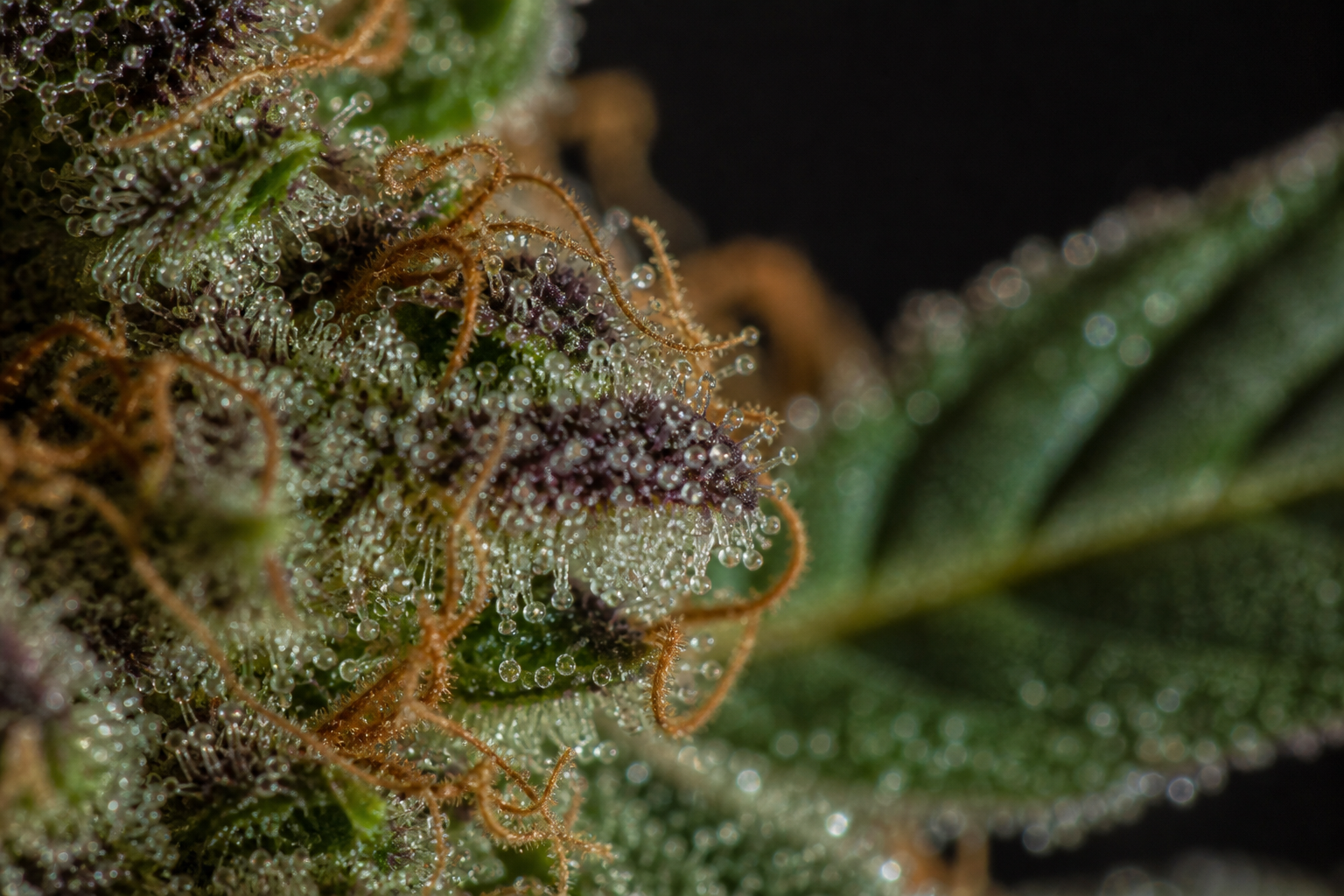
The physics: boiling-point charts are a lie you were sold
The internet is wallpapered with terpene "boiling points." α-Pinene at 155 °C. β-Myrcene at 168 °C. Limonene at 176 °C. Terpinolene at 185 °C. β-Caryophyllene at 263 °C. Humulene somewhere north of that. The implication, usually left unspoken, is that nothing interesting evaporates until you hit those temperatures. That is not how liquids work.
Boiling point is the temperature at which a compound's vapor pressure equals ambient atmospheric pressure. Below that temperature, the compound still evaporates. It evaporates every second there is a gas-phase deficit above it. A jar at 20 °C is not "too cold for terpenes to leave." It is a continuous vapor–liquid equilibrium in which the most volatile species partition into the headspace first.
Eyal, Raz, and colleagues at Bazelet and Hadassah Hebrew University Hospital spent a paper demolishing this exact misconception (Eyal et al., 2023; online 2022). Their argument is blunt: relative evaporation rate tracks vapor pressure, not the boiling-point poster. Calculated ambient vapor pressures put β-myrcene at roughly 80 times the vapor pressure of β-caryophyllene. At 20 °C, α-pinene evaporates about three times faster than limonene (Eyal et al., 2023, https://doi.org/10.1089/can.2021.0173).
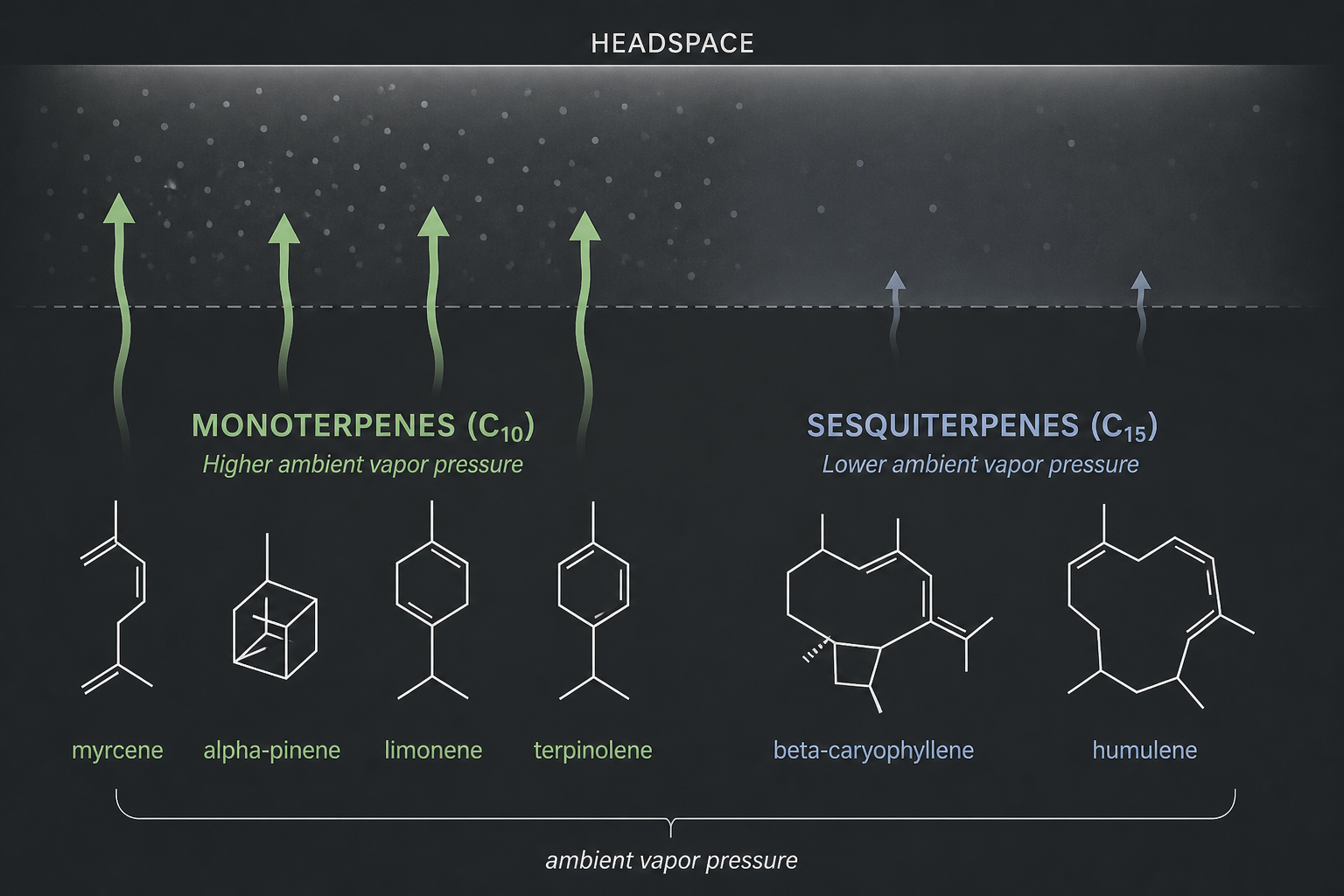
That is the whole game in one ratio. C10 monoterpenes — myrcene, pinene, limonene, terpinolene — are small, relatively nonpolar, and they want out. C15 sesquiterpenes — β-caryophyllene, humulene — are heavier and they linger. Dry the plant, jar it, and the profile you smell is not "the plant." It is whatever the still has not finished stripping.
Eyal's group said the quiet part out loud: dried inflorescence, however it was dried, is already not a full-spectrum composition (Eyal et al., 2023). "Full spectrum" on a bag of cured flower is marketing language for a fraction that physics already edited.
Two caveats, because this desk does not do slogans:
- Vapor pressure is not a death sentence with a stopwatch. Rate depends on temperature, surface area, headspace volume, how often you open the lid, and how much of the glandular cuticle is still intact. The 80× figure is a relative driving force, not a promise that myrcene is gone by Tuesday.
- Oxidation is a second, slower crime. Evaporation removes molecules. Oxygen, heat, and light convert the ones that stay — terpenes to alcohols, ketones, aldehydes, and oxides (Turek and Stintzing, 2013, https://doi.org/10.1111/1541-4337.12006). A jar can lose the top notes and stale what remains. Those are different reactions. People collapse them into "it went hay."
The timeline: Mississippi measured this in 1996 and the industry still acts surprised
Samir Ross and Mahmoud ElSohly steam-distilled indoor Cannabis sativa buds at four points and ran the oil on GC/FID and GC/MS (Ross and ElSohly, 1996, https://doi.org/10.1021/np960004a). Fresh-weight oil yield:
| Material | Oil yield (fresh wt) | Cumulative loss vs fresh |
|---|---|---|
| Freshly collected buds | 0.29% | — |
| Air-dried 1 week at room temperature | 0.20% | 31.0% |
| Dried 1 week, then stored 1 month | 0.16% | 44.8% |
| Dried 1 week, then stored 3 months | 0.13% | 55.2% |
The composition of what oil remained shifted the way a still predicts. Monoterpenes as a percentage of the oil: 92.48 → 85.54 → 67.60 → 62.02. Sesquiterpenes, same table: 6.84 → 12.64 → 29.53 → 35.63 (Ross and ElSohly, 1996). Nothing exotic disappeared from the chromatogram. The profile did not "become a different cultivar." The loud fraction left. The heavy fraction became relatively richer because it was slower to leave.
Fresh-bud oil in that study was dominated by β-myrcene and limonene — the two principal monoterpenes they reported (Ross and ElSohly, 1996). Those are exactly the species Eyal's vapor-pressure table says should go first.
Honesty about the apparatus, because the metaphor is a still and Ross did not use a mason jar: the one-month and three-month points were buds dried a week at room temperature, then held in a brown paper bag. That is an open-ish system, not a gasketed glass. Paper is worse than glass for retaining volatiles. A sealed jar is not innocent — it still has headspace, it still equilibrates, and every opening vents the vapor — but it is not a paper sack on a shelf. If anything, Ross understates how much a careless container can take, and overstates how fast a competent sealed jar must fail. The direction of the loss is not in dispute. The exact week-by-week number on your jar was not measured in Oxford, Mississippi in 1996.
The qualitative punchline from the same paper is the one marketers should hate: drying did not change the identity of the oil enough to fool a trained nose into thinking it was a different plant. The odor remained recognizable. What changed was intensity and the mono-to-sesqui ratio. "It still smells like herb" is a low bar. "It still smells like the jar you opened in week one" is the bar that physics keeps failing.
Grind, freezer, light: the Technion year-long insult to received wisdom
Looz Milay, Paula Berman, Anna Shapira, Ohad Guberman, and David Meiri at the Technion stored whole versus ground inflorescences in the dark at 25 °C, 4 °C, −30 °C, and −80 °C for a year (Milay et al., 2020, https://doi.org/10.3389/fpls.2020.583605). They cured first — one month, dark, 21 °C and 60% relative humidity, in sealed glass opened every 48 hours — then locked moisture and started the clock. That 21 °C / 60% RH protocol is what the paper actually used. It is not "60/60." The folklore number, 60 °F / 60% RH, is industry shorthand. The literature that exists uses 21 °C / 60% RH (Milay) or 15 °C for controlled-atmosphere drying (Birenboim et al., 2024, https://doi.org/10.3390/plants13071049). Treat 60/60 as a rumor with a nice shape.
Terpenoid result, stated the way they stated it: average terpenoid concentration decreased by more than 50% by month four, under every storage condition they tested (Milay et al., 2020). They contrasted that with an average 26% loss of biosynthesized phytocannabinoids at twelve months. The aroma fraction is not more durable than the cannabinoid fraction. It is the first thing to go.
Two conditions were worst for terpenes: grinding, and storage colder than −20 °C. Whole inflorescences at 4 °C were the best of the set they ran (Milay et al., 2020). Read that again if you keep the stash in the freezer "to preserve it." The freezer is where α-pinene went to die in this experiment. −80 °C was generally the most destructive temperature for the terpenoid panel; −30 °C was also unfavorable. β-Caryophyllene, the stubborn sesquiterpene, still dropped significantly t0 to t4 at every temperature. The monoterpenes just had farther to fall.
Why grind is obvious: you increase surface area, you rupture glandular heads, you give the headspace more oil to work with. A ground sample is a still with more packing. Why deep freeze is worse is not fully resolved in the paper. Milay et al. report the outcome. They do not publish a trichome-fracture percentage, and this article will not invent one. Ice-crystal rupture of cuticles is a plausible mechanism. So is freeze-concentration and a later thaw that dumps volatiles into a damaged matrix. Vendor blogs that quote a tidy "20–30% ruptured heads" number are not primary literature. Flagged. Killed.
Light: Milay stored everything in the dark, so this paper cannot be cited for a light-versus-dark terpene delta. What is published is the essential-oil review: temperature, light, and oxygen are the three extrinsic drivers of terpene degradation (Turek and Stintzing, 2013). Photochemistry is real. A windowsill jar is a stupid place to keep a volatile oil. I will not pretend someone measured the exact loss curve for cannabis monoterpenes under a 5000 K bulb, because they did not in the papers this article is allowed to use.
One more Milay observation that wrecks a different piece of folklore: CBN, the internet's favorite "aging marker," was undetectable at t0 and still sat under 0.01% w/w in their Type III (CBD-rich) chemovar after a year (Milay et al., 2020). If your COA is a CBD-dominant flower and someone is reading CBN like a carbon-date, they are reading the wrong clock. Terpenes are the clock that actually moves.
What a connoisseur actually smells when "gas" becomes "hay"
The nose is not a terpene table. It is a detector with ridiculous dynamic range and a habit of naming mixtures as if they were single notes.
The top of the still — what leaves first.
Monoterpenes are the bright, spreading, heady, "this room just changed" fraction. Myrcene is herbal, tropic, a little metallic when it is loud. Pinene is pine and solvent-clean. Limonene is citrus peel, not candy. Terpinolene is the weird one: woody-citrus, incense, the note people call "classic" when they mean a 1990s profile. When those C10s drop, the jar does not go silent. It goes narrow. What you have left is the base.
"Gas" is not a terpene. Oswald and colleagues at Abstrax identified a family of prenylated volatile sulfur compounds as the actual skunk/gas odorants, with 3-methyl-2-butene-1-thiol as the primary punch (Oswald et al., 2021, https://doi.org/10.1021/acsomega.1c04196). Those VSCs rose late in flower, peaked during cure, and then dropped after about a week of storage. Thiols are viciously volatile. If monoterpenes are the first cut of the still, VSCs are the heads — gone before the rest of the run even notices. A jar that "had gas on drop" and smells like a cedar chest three weeks later did not "lose its terps" in the abstract. It lost a sulfur fraction most COAs do not even report, then the monoterpenes, in that order.
The bottom of the still — what you are left smelling.
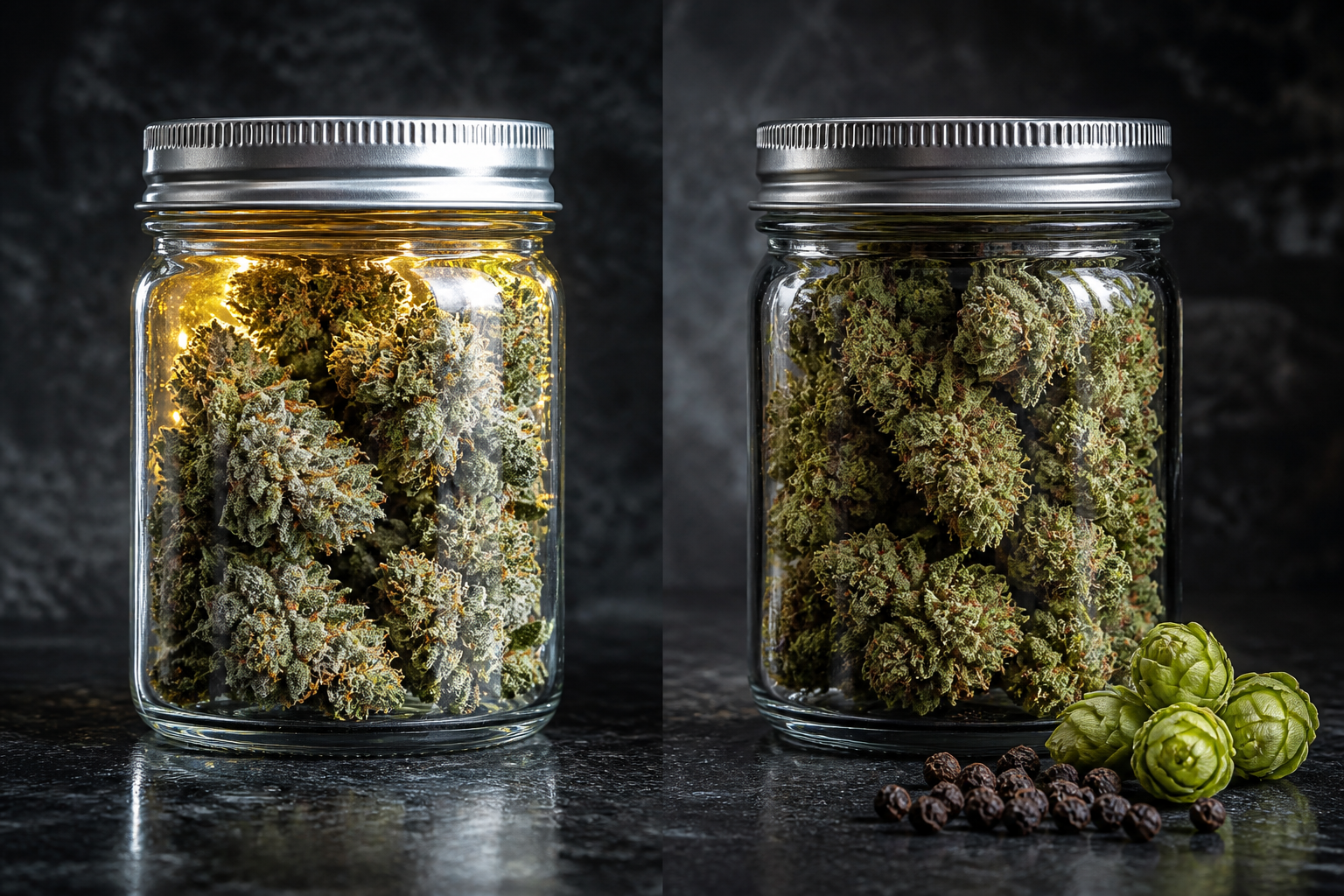
β-Caryophyllene is black pepper, clove, a warm woody bite. Humulene is hops and dry herb. Together they read as "spice and wood" once the citrus and pine have left the building. That is not a new cultivar. That is a stripped one. Ross's oil went from a monoterpene-dominated mixture to a mixture in which sesquiterpenes had more than quintupled their share of what remained (Ross and ElSohly, 1996). Your nose is doing the same integration, without a FID.
The oxidized fraction — the part that actually stinks of old.
Evaporation is subtraction. Oxidation is substitution. Turek and Stintzing catalog the usual products: alcohols, ketones, aldehydes, epoxides, polymers (Turek and Stintzing, 2013). In cannabis, some of those classes have been attributed to oxidation products on the plant (Calvi et al., 2018, cited in Milay et al., 2020). Caryophyllene oxide is the one people have heard of — the woody, dry, slightly dusty note, and the compound detector dogs are trained on. Gertsch et al. (2008) showed that (E)-β-caryophyllene itself binds CB2 with a Ki of 155 ± 4 nM; caryophyllene oxide and α-humulene did not (Ki > 20 µM) (https://doi.org/10.1073/pnas.0803601105). That is receptor-level chemistry, not a human outcome. The point for a jar is cruder: the sesquiterpene that stayed can oxidize into a molecule that is both a different smell and, at the one receptor anyone has measured cleanly, a dead ligand.
"Hay" is two different failures wearing the same nickname.
- Evaporative hay. The bright fraction is gone. The remaining oil is woody-spicy-dull. People call that hay because they lack a better word for "the top notes distilled off."
- Cure hay. Fast, hot, or incomplete dry that leaves chlorophyll character and a green-tea / dried-grass note. The food-chemistry path is chlorophyll → pheophytin under acid and heat. A cannabis-specific kinetic paper for that conversion was not retrieved. Flagged as a gap. Do not let anyone sell you a pheophytin percentage for flower. The sensory fact remains: rushed dry smells like a barn. That is a handling failure, not a vapor-pressure story. It can coexist with the still. It is not the same crime.
A jar that smells like hay failed physics, or failed a dry room, or both. It did not fail a "strain."
How to read a terpene table for this — not a lab-report tutorial
This site already has a piece on how to read a lab report. Do not re-read it here. For the still problem you need two fields and a refusal to be impressed by the wrong ones.
1. The date.
A terpene table without a harvest or test date is a rumor. Ross lost 31% of oil in a week of room-temperature drying and 44.8% by one month in a paper bag (Ross and ElSohly, 1996). Milay lost more than half the terpenoid panel by month four in sealed storage, in the dark, after a proper cure (Milay et al., 2020). If the COA is older than the story the jar is telling, believe the jar. The paper described a plant that no longer exists.
2. The monoterpene-to-sesquiterpene shape, not the total.
Look at the named rows. Myrcene, α-pinene, β-pinene, limonene, terpinolene, ocimene — those are the high-VP fraction. β-Caryophyllene and humulene are the ballast. A profile that is almost all caryophyllene/humulene with a ghost of myrcene is either a caryophyllene-forward chemovar or a distilled one. You cannot tell from a single snapshot. You can tell from a snapshot plus a date plus a nose. If the COA from three months ago shows a loud myrcene/pinene stack and the jar now smells like a grind of black pepper and cardboard, you are not holding a mystery. You are holding Ross's table in three dimensions.
Total terpene percent is a vanity metric if the fraction underneath it has already been fractionated. A flower that is still monoterpene-heavy will out-smell another with the same total sitting in a sesquiterpene graveyard. The number on the line labeled "total terpenes" does not disclose the cut.
3. What the table will not tell you.
Most panels do not quantify prenylated thiols. Oswald's gas note is usually invisible on the PDF you were handed (Oswald et al., 2021). A "myrcene-dominant" COA can still have been a gas cultivar on the day it was tested and a spice jar on the day you opened it. Absence of a VSC row is not absence of the chemistry. It is absence of the assay.
Water activity is the other missing number. ASTM D8197 specifies aw 0.55–0.65 for dry cannabis flower: below 0.65 against microbial growth, above 0.55 against physical breakage in handling (ASTM D8197-22, https://www.astm.org/d8197-22.html). Brittle flower sheds trichomes. Shed trichomes are surface area. Surface area is a faster still. Moisture percentage is not a substitute; water activity is the spec.
4. Receptor papers, since someone will bring them up.
Terpenes are not inert perfume. They are ligands in some assays and not in others. Raz et al. (2023) reported that selected cannabis terpenes activate CB1 in a heterologous in-vitro system at a fraction of THC's activation, and that some combinations with THC increase that activation — receptor-level, in vitro, not a human effect (https://doi.org/10.1016/j.bcp.2023.115548). Santiago et al. (2019) found no CB1/CB2 activation or THC modulation by six common terpenoids in their assay (https://doi.org/10.1089/can.2019.0016). Gertsch's BCP–CB2 result is the cleanest single-molecule story and it is still a binding/functional-cell/mouse-inflammation paper, not a patient trial (Gertsch et al., 2008). Namdar et al. (2019) showed, in cell-cytotoxicity work, that terpenoids co-produced with a given cannabinoid behaved differently from mismatched ones (https://doi.org/10.3390/molecules24173031). The chemistry argument is: the identity and ratio of the volatile fraction is not cosmetic. The journalistic argument is: none of that is a reason to claim a cultivar "treats" anything. If the monoterpenes have left the jar, the mixture those papers studied is not the mixture you have.
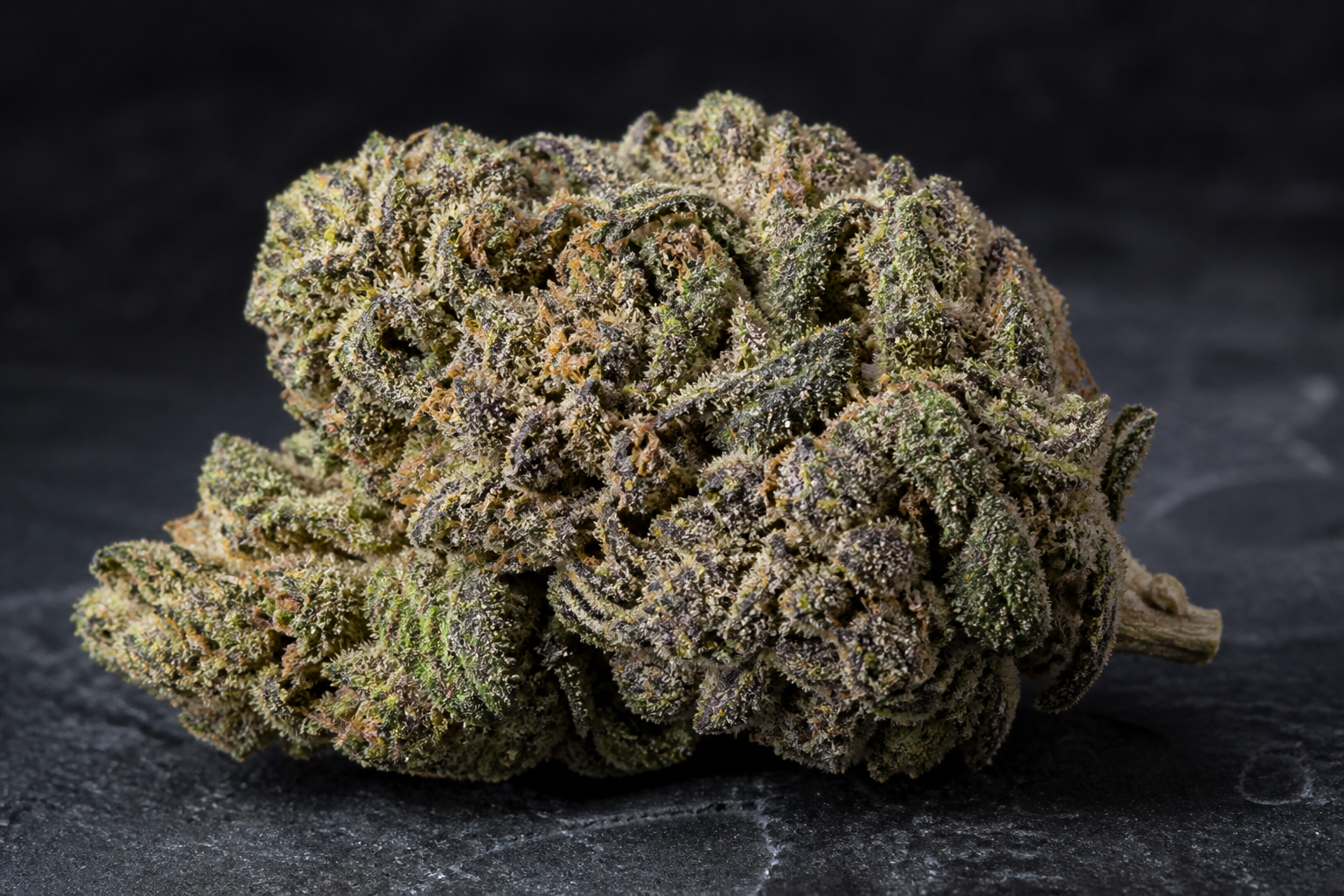
Why freshness and a terpene COA exist — and why a hay jar is a physics fail
CincyCannaDash does not "guarantee loud." Loud is a chemical state with a half-life. What a quality review can do is refuse to pretend a stripped jar is the plant on the paperwork.
The five-point review on this desk is not a slogan stack. It is the minimum set that makes the still visible:
- Visual — density, trim, color, trichome coverage. Collapsed, smeared, or amber-beyond-reason heads are a handling and senescence tell, not a "ripeness setting."
- Terpene verification — a full-panel COA with a terpene table, not a cannabinoid-only strip.
- Potency confirmation — the cannabinoid panel, because it is the legal and analytical backbone, not because it predicts the nose.
- Compliance screening — pesticides, heavy metals, microbials. A loud jar that fails a screen is still a fail.
- Freshness — cure-tested, stored, handled. The part this article is about.
If the terpene table is old, sesquiterpene-heavy, and the jar smells like a feed store, the flower did not "lose quality in a mysterious way." It ran a distillation. Southern Ohio summers do not help — heat raises vapor pressure; Eyal's entire point is that ambient is already enough (Eyal et al., 2023). A cool, dark, whole-flower hold at refrigerator temperature is what the Technion paper actually crowned (Milay et al., 2020). A freezer, a grinder, a paper bag, a dashboard: those are how you volunteer for Ross's three-month column. If the nugs used to be sticky and now they smell like a barn, that is physics, not a personality.
This is not a reason to fetishize a humidity packet or a ritual. It is a reason to look at the date on the PDF, smell the jar like you mean it, and treat "hay" as a physical diagnosis instead of a personality trait of the plant.
The plant is not the problem. The still is.
Sources
- Ross SA, ElSohly MA. The volatile oil composition of fresh and air-dried buds of Cannabis sativa. Journal of Natural Products. 1996;59(1):49–51. https://doi.org/10.1021/np960004a
- Eyal AM, Berneman Zeitouni D, Tal D, Schlesinger D, Davidson EM, Raz N. Vapor pressure, vaping, and corrections to misconceptions related to medical cannabis' active pharmaceutical ingredients' physical properties and compositions. Cannabis and Cannabinoid Research. 2023;8(3):414–425. (Published online 2022.) Bazelet Medical Cannabis Group and Hadassah Hebrew University Hospital. https://doi.org/10.1089/can.2021.0173
- Milay L, Berman P, Shapira A, Guberman O, Meiri D. Metabolic profiling of cannabis secondary metabolites for evaluation of optimal postharvest storage conditions. Frontiers in Plant Science. 2020;11:583605. Technion — Israel Institute of Technology. https://doi.org/10.3389/fpls.2020.583605
- Birenboim M, Brikenstein N, Duanis-Assaf D, Maurer D, Chalupowicz D, Kenigsbuch D, Shimshoni JA. In pursuit of optimal quality: cultivar-specific drying approaches for medicinal cannabis. Plants. 2024;13(7):1049. https://doi.org/10.3390/plants13071049
- Turek C, Stintzing FC. Stability of essential oils: a review. Comprehensive Reviews in Food Science and Food Safety. 2013;12(1):40–53. https://doi.org/10.1111/1541-4337.12006
- Oswald IWH, Ojeda MA, Pobanz RJ, Koby KA, Buchanan AJ, Del Rosso J, Guzman MA, Martin TJ. Identification of a new family of prenylated volatile sulfur compounds in cannabis revealed by comprehensive two-dimensional gas chromatography. ACS Omega. 2021;6(47):31667–31676. https://doi.org/10.1021/acsomega.1c04196
- ASTM International. D8197-22: Standard specification for maintaining acceptable water activity (aw) range (0.55 to 0.65) for dry cannabis flower intended for human/animal use. https://www.astm.org/d8197-22.html
- Gertsch J, Leonti M, Raduner S, et al. Beta-caryophyllene is a dietary cannabinoid. Proceedings of the National Academy of Sciences. 2008;105(26):9099–9104. https://doi.org/10.1073/pnas.0803601105
- Raz N, Eyal AM, Berneman Zeitouni D, et al. Selected cannabis terpenes synergize with THC to produce increased CB1 receptor activation. Biochemical Pharmacology. 2023;212:115548. Receptor-level in vitro; not a human effect. https://doi.org/10.1016/j.bcp.2023.115548
- Santiago M, Sachdev S, Arnold JC, McGregor IS, Connor M. Absence of entourage: terpenoids commonly found in Cannabis sativa do not modulate the functional activity of Δ9-THC at human CB1 and CB2 receptors. Cannabis and Cannabinoid Research. 2019;4(3):165–176. https://doi.org/10.1089/can.2019.0016
- Namdar D, Voet H, Ajjampura V, et al. Terpenoids and phytocannabinoids co-produced in Cannabis sativa strains show specific interaction for cell cytotoxic activity. Molecules. 2019;24(17):3031. In-vitro cell chemistry; not a patient outcome. https://doi.org/10.3390/molecules24173031
- Calvi L, Pentimalli D, Panseri S, et al. Comprehensive quality evaluation of medical Cannabis sativa L. inflorescence and macerated oils based on HS-SPME coupled to GC–MS and LC-HRMS. Journal of Pharmaceutical and Biomedical Analysis. 2018;150:208–219. https://doi.org/10.1016/j.jpba.2017.11.073 — cited via Milay et al. 2020 for oxidation-product classes.
Flagged / not used as numbers: vendor claims of 20–30% trichome-head rupture in conventional dry rooms (not primary); "100 °F / 24 h = 15% THC loss" (not primary); Gold Coast / similar boiling-point evaporation blogs; cannabis-specific chlorophyll → pheophytin kinetics (literature gap); 60 °F / 60% RH as a validated optimum (lore; papers use 15 °C or 21 °C / 60% RH).
Series note
This is chapter 1 of a CincyCannaDash quality library. The jar is the still. Future chapters, in this order:
- The 20% lie / the 2% truth — labeled potency, lab shopping, and why a terpene table beats a THC flex.
- Amber is senescence — trichome-head collapse is not a ripeness dial you set.
- Same name ≠ same plant — cultivar names fail chemistry; chemovars do not.
- Israel after Mechoulam — storage, drying, and receptor work from the labs that kept measuring after the origin story ended.
The live board is today's menu. Dated lab reports sit next to the lots, and areas lists the Southern Ohio towns we already serve. (513) 986-5438.
More notes
- The lid ring is the seal
- The tape is the memory
- The working jar is the small one
- The bag is not a jar
- The empty jar is a bigger still
- The grind is the last harvest
- Two OGs, same family
- The fridge is a wet box
- Light is the faster insult
- The dash is a kiln
- The pack is not a cure
- The freezer is not a time machine
- Amber is senescence
- The name is not the plant
- How pick up and delivery works
- How to read a lab report