
Crack a jar of kind that still looks loud from arm's length — frosty nugs, sticky to the finger, the room already a little heady — and put a jeweler loupe on one calyx. Some of those crystals are still balloons: round, taut, clear going cloudy. Some are already pancakes. Some are gone. The stalk is still there, a little twisted, wearing nothing.
The forum told you amber was a dial. Ten percent amber for this, fifty for that, wait until they all turn and you have "body." The microscope does not care about the forum. Clear to cloudy to amber is not a ripeness setting you set. It is a cuticle failing in public.
The jar is a still — that was chapter 1. This chapter is the balloon that feeds it. Frost is a bag of those balloons. Broken balloons leak.
This is not grower folklore with a lab coat on. It is cryo-SEM from a group that counted heads, measured stalks, photographed resin droplets on the cuticle, and then did the unglamorous thing: they compared a hand-trimmed nug to a machine-trimmed one.
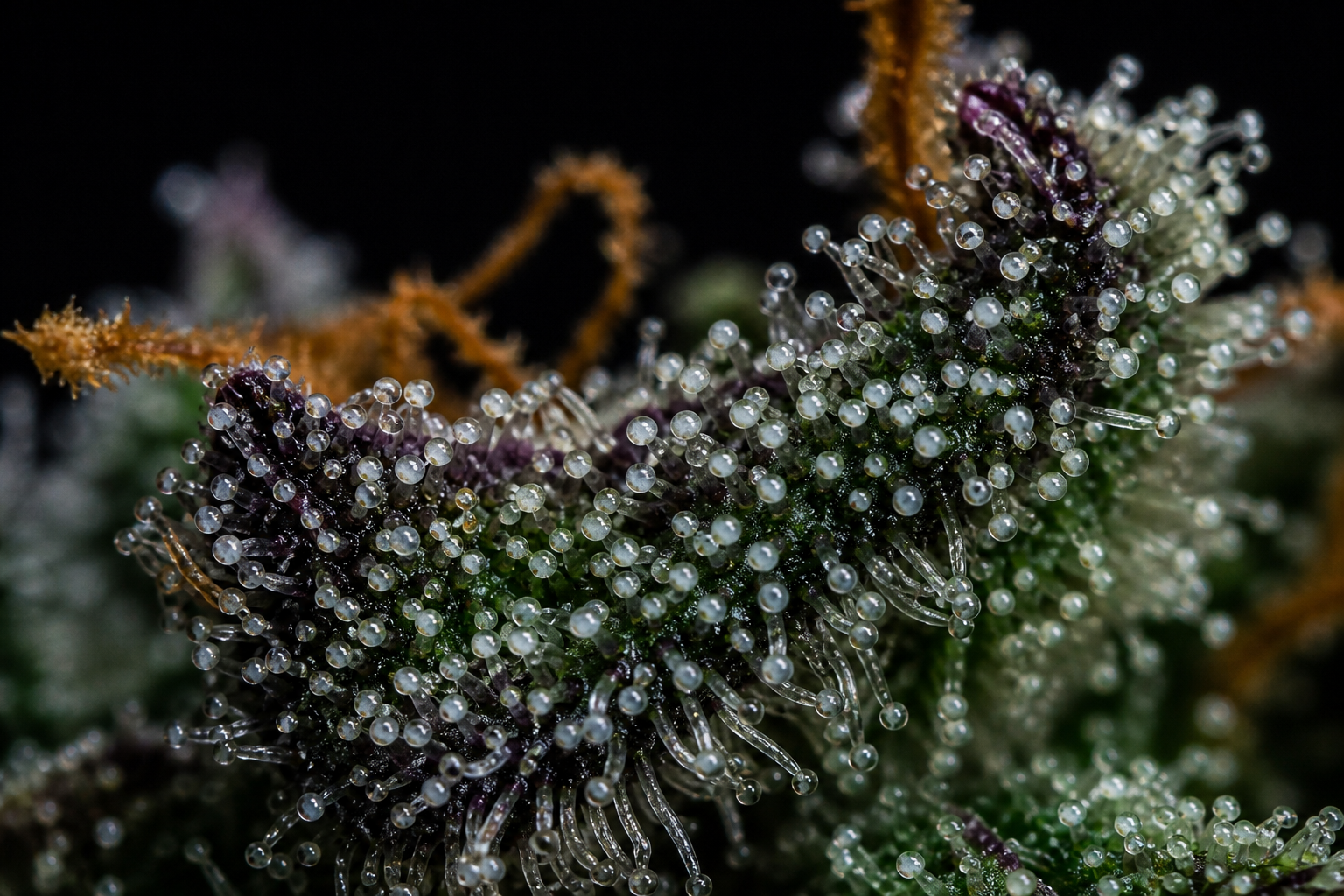
The reservoir is a balloon on a stalk, not a sparkle
Zamir Punja, Darren Sutton, and Tommy Kim at Simon Fraser University grew two indoor genotypes — Moby Dick and Space Queen — side by side, sampled bracts from week 3 of flower through week 8, and looked at them under light microscopy and cryo-scanning electron microscopy (Punja, Sutton, and Kim, 2023, https://doi.org/10.1186/s42238-023-00178-9). The objects that make a nug look sugared are capitate glandular trichomes: a stalk, a ring of secretory disc cells, a head wrapped in cuticle. Cannabinoids and terpenes accumulate in that head. The sparkle is a storage tank.
The tanks are small. Across those two genotypes, glandular heads ran 40–110 μm in diameter. Stalks ran 20–1100 μm — from almost sessile to a millimeter of pedicel. At six weeks, Moby Dick heads were larger (~90 μm versus ~75 μm for Space Queen; n = 25). Space Queen stalks were longer (~500 μm versus ~300 μm). Space Queen carried significantly more capitate trichomes than Moby Dick at every sampling time (P = 0.05). At six weeks, both genotypes had more stalked-capitate heads on the lower bract surface than the upper. Same room. Same weeks. Two different forests of balloons (Punja et al., 2023).
That is already enough to retire one piece of bag-appeal theology: "frost" is not a single trait. It is a count, a stalk length, a head diameter, and a developmental stage, and the plant does not keep those in sync for your convenience. Punja's schematic is blunt about the asynchrony. Heads initiate through the flowering period. At any given week you are looking at a mixture.
Stalk length is not cosmetic. Livingston and colleagues defined stalked versus sessile heads by autofluorescence and disc-cell count, then showed that stalk elongation tracks a bigger secretory disc and a richer metabolite load (Livingston et al., 2020, https://doi.org/10.1111/tpj.14516). Stalked heads: 12–16 secretory disc cells, blue autofluorescence correlated with high cannabinoid levels, strongly monoterpene-dominant terpene profiles. Sessile heads on mature flowers and vegetative leaves: eight disc cells, red-shifted autofluorescence, less monoterpene-dominant profiles. Their model: the stalked gland grows out of a sessile-like precursor. This desk will not invent a milligram-per-head number they did not publish. A bald stalk is not a "trim aesthetic." It is a factory with the tank knocked off.
Small and Naraine put average head diameter at 129 μm in high-THC drug-type plants versus 80 μm in hemp (Small and Naraine, 2016, https://doi.org/10.1007/s10722-015-0254-2). Punja's two indoor genotypes sat in a 40–110 μm window. The balloon is not one size.
Amber is a funeral color, not a harvest recipe
The color story everyone already knows is not wrong as a sequence. It is wrong as a dial. Heads go clear (translucent) to cloudy (milky) to amber (brown). Punja photographed that sequence on Hash Plant and ran the heads through CIELAB color space. Translucency fell and the red score rose from week 3 to week 5 to week 7 — significant in both directions (Punja et al., 2023). Under UV, the heads autofluoresce; after they secrete, that autofluorescence dims. The chemistry inside the balloon is changing, and some of it is no longer inside.
What the color story pretends is that you can set a percentage. Harvest at "mostly cloudy, some amber." Wait for "all amber" if you want a heavier kind. That is a slider on a YouTube timeline. It is not a measurement of a bract.
One Hash Plant image at week 8, in that same figure, was counted at 83 clear / 96 milky / 52 brown (Punja et al., 2023, Fig. 13d). Read that sentence again before you tattoo a ratio on a dry-room whiteboard. That is one image, of one bract, of one genotype, used to show that their circle-finding algorithm could separate classes. It is not a harvest rule. It is not "the" mix at week 8. Punja's whole morphological point is the opposite: formation is asynchronous, so a bract at harvest is a mixed population by design. A single frame that happens to contain 83/96/52 is a demonstration, not a recipe.
Their schematic puts the start of dehiscence, secretion, and senescence around week 5, progressing through harvest at week 8 in the two genotypes they tracked. Stress can accelerate the timetable. Premature browning as early as week 5 is flagged in that paper as the authors' unpublished observations — heat and drought, they note, can brown heads before the gland is fully mature. This desk will not launder unpublished observations into a measured week. It is a warning label, not a data point.
Paul Mahlberg and Eun-Soo Kim, who spent a career inside these glands, suggested that senescent, over-mature glands hold less THC because of secretion and volatilization (Mahlberg and Kim, 2004). Suggested. Not a percentage this article will invent. The mechanism Punja photographed is the mechanism those authors were pointing at: the tank empties onto its own surface, then collapses.
If you have been using amber as a personality — "this one was grown for evening" — you have been reading a bruise as a cultivar.
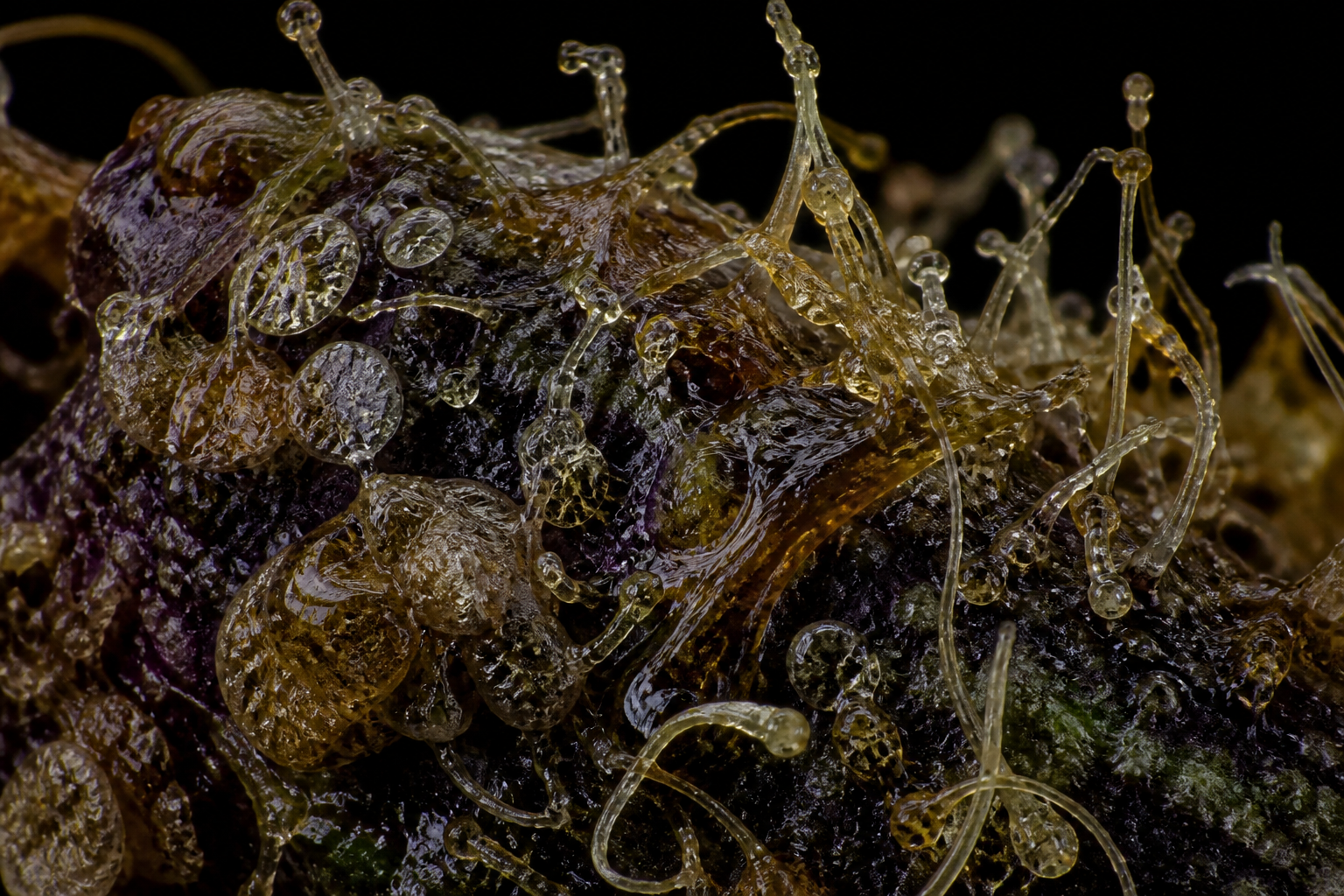
SEM does not show a ripe switch. It shows a leak
At six and eight weeks, Punja's cryo-SEM starts finding droplets on the cuticle of both bulbous and capitate heads. The droplets are about 2 μm. They bulge the surface. Several can sit on one head. The cuticle, which was a smooth drum, goes sticky. Heads fuse. Aggregates of five to six heads show up, glued by their own resin. Then the geometry that made the balloon a balloon fails: the cuticle dimples inward, wrinkles, sometimes tears. Where it tears, the dense granular resin underneath is visible. The head shrinks. Then it looks dried and convoluted — senescent in the unromantic sense. Then, often, it comes off (Punja et al., 2023).
The constriction at the top of the stalk is a built-in weak point. Once the head is mature, that neck is where dehiscence happens. What you call "kief in the bottom of the jar" is, in part, a pile of detached reservoirs. What you call "smeared frost" is resin that is no longer behind a cuticle.
The sequence, in the order the micrographs actually show it:
- Intact head, turgid cuticle, disc cells visible as a ring.
- Resin droplets on the outside. Stickiness. Fusion.
- Inward collapse. Wrinkle. Tear.
- Senescent, dried, convoluted head — or a bare stalk.
None of those steps is a "ripeness setting." They are the gland finishing, then failing. A nug can wear all four at once, because the plant never synchronized them for you. That is why a loupe that only asks "what color?" is a blunt instrument. Color is a correlate of this sequence. It is not a control knob.
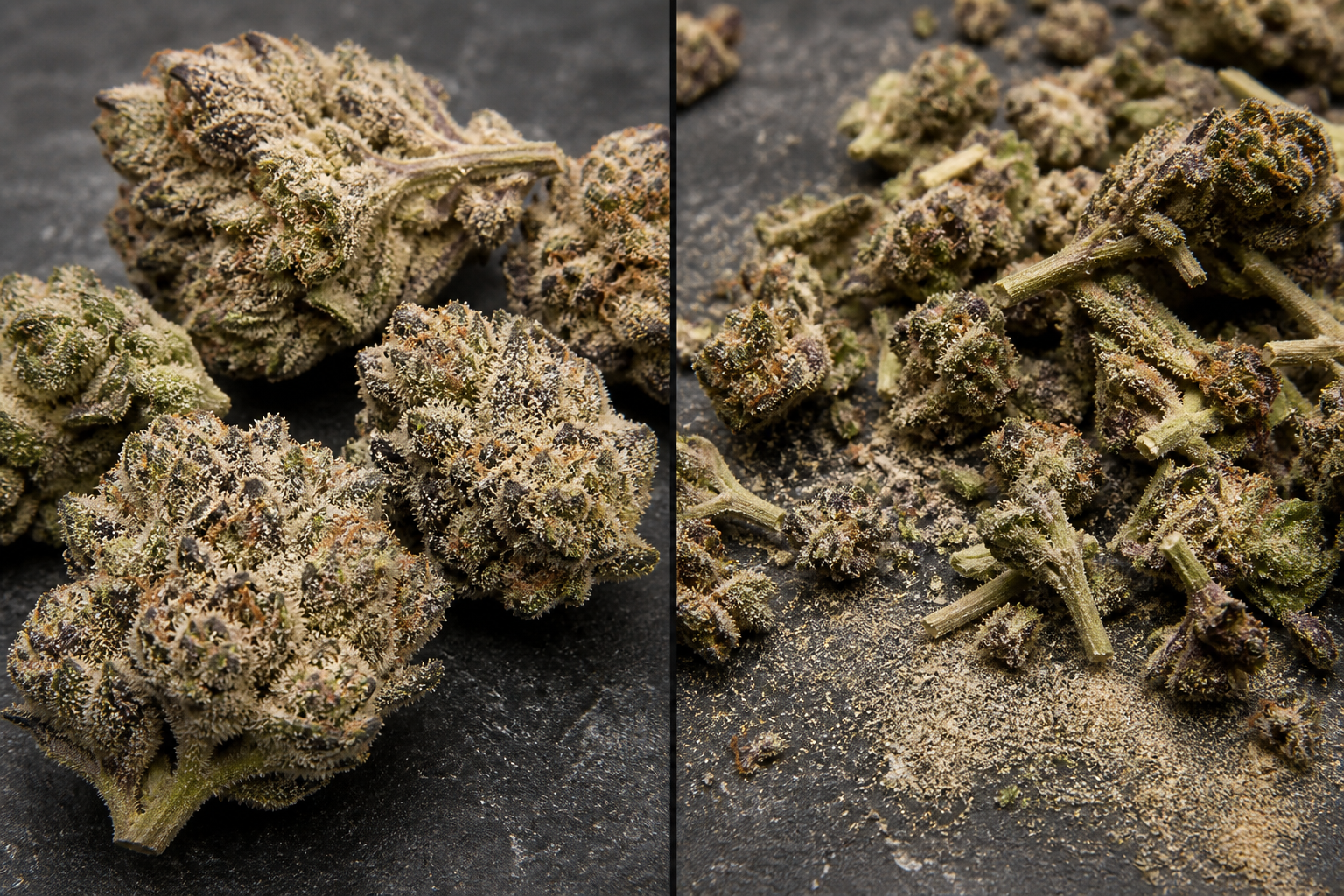
Machine trim is a hailstorm. Hand trim is a haircut. Drying is usually not the villain
After harvest, the heads have a second chance to die of blunt force.
Punja took Pink Kush through a commercial dry room — 21–24 °C, 50–55% RH, five days — and compared a hand-trimmed sample to a machine-trimmed one under SEM. Hand-trim: heads intact, little physical damage. Machine-trim: many heads detached or collapsed, bare stalks left behind, worst at the bract edges (Punja et al., 2023). That is not a terpene story and it is not a harvest-window story. It is a mechanical one. The balloon sits on a thin neck. A tumbler does not negotiate with thin necks.
The dry itself, at those temperatures, was the milder insult. Stalks shriveled and twisted — you can see the outlines of the epidermal and hypodermal cells that built them. The majority of heads were not shriveled. The cuticle was intact. Punja is explicit: moderate-temperature drying did not wreck the cuticle the way high-temperature drying wrecks glandular heads in other oil plants. If your nugs came out of a 21–24 °C room looking bald, do not blame the hygrometer first. Blame the trim.
They then looked at four hand-trimmed, commercially dried genotypes, 25 heads in each of three replicate frames (n = 75):
| Genotype | Density | Stalked:unstalked (or sessile note) | Dehisced / senescent |
|---|---|---|---|
| Skunk | ~18 / mm² | stalked:unstalked 0.79 | few dehisced |
| Temple Spice | ~12 / mm² | sessile proportion 0.15; some heads stuck | resin already gluing heads |
| Healer | ~20 / mm² | stalked 0.99 | dehisced:senescent 0.38 |
| Terpenade | ~30 / mm² | no sessile visible | dehisced:senescent 0.68 |
Same handling class. Four different forests. Terpenade is crowded and already shedding. Skunk is less crowded and still holding. Density is not quality by itself — Terpenade's 30 per square millimeter did not save it from a 0.68 dehisced-to-senescent ratio. A sticky, heady jar of that plant on week one of flower is not the same object as the dried, hand-trimmed sample in that table. Genotype sets the starting forest. Handling decides how much of the forest is still standing. Senescence decides how many balloons are still balloons (Punja et al., 2023).
Vendor blogs that quote a tidy 20–30% ruptured-heads number for conventional dry rooms are not this paper and not any primary this desk will use. Flagged. Killed. Punja did not publish that percentage. This article will not launder it.
What a connoisseur actually looks at — and why the five-point review exists
A loupe in a Southern Ohio kitchen is not an SEM. It will, if you let it, tell you whether the balloons are still balloons.
Look at the bract edge first. That is where Punja's machine-trim damage was ugliest. Intact heads are globes — clear to cloudy, maybe a hint of amber, still spherical. Collapsed heads look deflated or smeared. Bald stalks are a tiny forest after hail: pedicels, no tanks. Sticky fingers can mean intact cuticle or resin already on the outside. The loupe is what tells those apart. Dank still in the head and dank already smeared on a sugar leaf are not the same stash.
Color is a clue, not a recipe. A mixed field of clear, cloudy, and some amber is what asynchronous development predicts. A field that is mostly brown, collapsed, and bald is not "ready." It is late, or it was handled like product, or both.
This site does not grade flower by a trichome-color pie chart, and it does not "guarantee loud." Loud is a chemical state with a half-life, living in a head that can leak. The five-point review on this desk is the minimum set that makes the balloon visible:
- Visual — intact versus collapsed or dehisced heads; trim that kept the forest versus trim that stripped it. Amber-beyond-reason is a senescence tell, not a ripeness setting.
- Terpene verification — a full-panel COA with a terpene table, not a cannabinoid-only strip. The oil that leaked is the oil the table was supposed to describe.
- Potency confirmation — the cannabinoid panel, because it is the legal and analytical backbone, not because a number predicts whether the heads are still on.
- Compliance screening — pesticides, heavy metals, microbials. A frosty jar that fails a screen is still a fail.
- Freshness / handling — when it was cut, how it was trimmed, how it was dried, how it was stored. The part this article is about.
If the nugs are bald at the edges, the COA can still be pretty. The COA described a plant that had not yet been through the tumbler. If the heads are intact, cloudy, a little sticky, and the terpene table is dated and monoterpene-forward, you are holding the reservoir and the receipt. If the heads are collapsed and the jar already smells like a spice drawer, the balloons already burst. The oil is on the outside now.
This is not a reason to fetishize a jeweler loupe as a personality. It is a reason to stop treating a senescence color as a cultivar, and to stop calling mechanically stripped nugs "the same kind, just trimmed tighter." Southern Ohio humidity and summer heat do not help a leaking cuticle, but they are not required for the leak. The gland will do this on a calendar. A machine will do it in a minute.
The plant is not the problem. The broken balloon is.
Sources
- Punja ZK, Sutton DB, Kim T. Glandular trichome development, morphology, and maturation are influenced by plant age and genotype in high THC-containing cannabis (Cannabis sativa L.) inflorescences. Journal of Cannabis Research. 2023;5:12. Open access. Simon Fraser University. https://doi.org/10.1186/s42238-023-00178-9
- Livingston SJ, Quilichini TD, Booth JK, Wong DCJ, Rensing KH, Laflamme-Yonkman J, Castellarin SD, Bohlmann J, Page JE, Samuels AL. Cannabis glandular trichomes alter morphology and metabolite content during flower maturation. The Plant Journal. 2020;101(1):37–56. https://doi.org/10.1111/tpj.14516
- Small E, Naraine SGU. Size matters: evolution of large drug-secreting resin glands in elite pharmaceutical strains of Cannabis sativa. Genetic Resources and Crop Evolution. 2016;63:349–359. https://doi.org/10.1007/s10722-015-0254-2
- Mahlberg PG, Kim E-S. Accumulation of cannabinoids in glandular trichomes of Cannabis (Cannabaceae). Journal of Industrial Hemp. 2004;9(1):15–36. https://doi.org/10.1300/J237v09n01_04 — cited for their suggestion that senescent, over-mature glands hold less THC via secretion/volatilization, not for a percentage.
Flagged / not used as numbers: vendor claims of 20–30% trichome-head rupture in conventional dry rooms (not primary); Punja's premature-browning-by-week-5 note (authors' unpublished observations, not a measured series); the 83 clear / 96 milky / 52 brown count (one Hash Plant image, not a harvest rule); any invented THC-loss percentage from amber or from machine trim; any "wait until X% amber" recipe.
Series note
This is chapter 2 of a CincyCannaDash quality library. Chapter 1 was the jar as still: /blog/your-cannabis-jar-is-a-still/. The heads leak; the still runs. Next: same name ≠ same plant — cultivar names fail chemistry; chemovars do not.
The live board is today's menu. Dated lab reports sit next to the lots, and areas lists the Southern Ohio towns we already serve. 21+. (513) 986-5438.
More notes
- The lid ring is the seal
- The tape is the memory
- The working jar is the small one
- The bag is not a jar
- The empty jar is a bigger still
- The grind is the last harvest
- Two OGs, same family
- The fridge is a wet box
- Light is the faster insult
- The dash is a kiln
- The pack is not a cure
- The freezer is not a time machine
- The name is not the plant
- How pick up and delivery works
- How to read a lab report
- Your cannabis jar is a still