
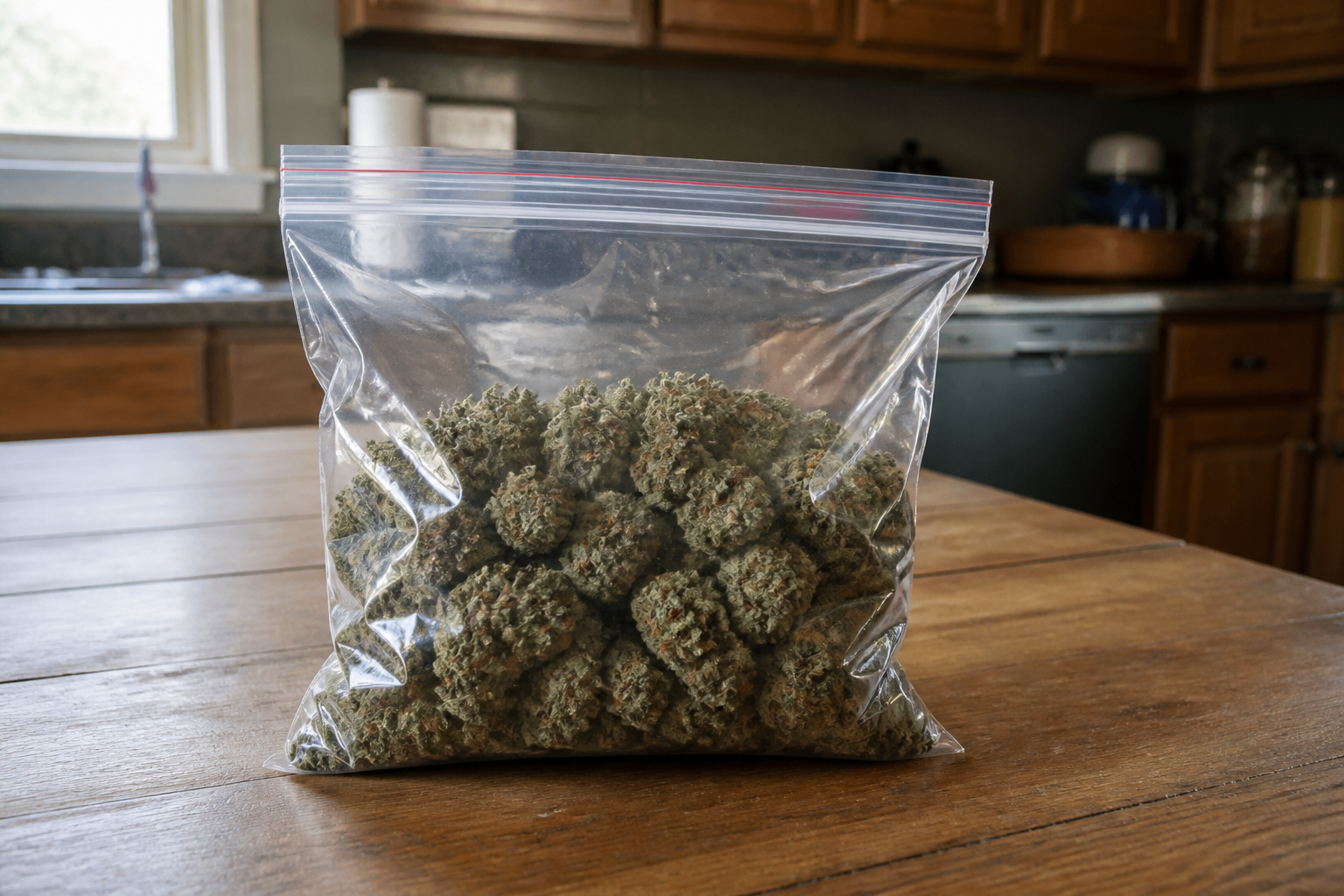
You dropped the zip bag in the kitchen drawer and called it stored. The zip was closed, and the nugs still looked loud. You open that drawer later and the whole thing smells like the bag. The wall let the room out.
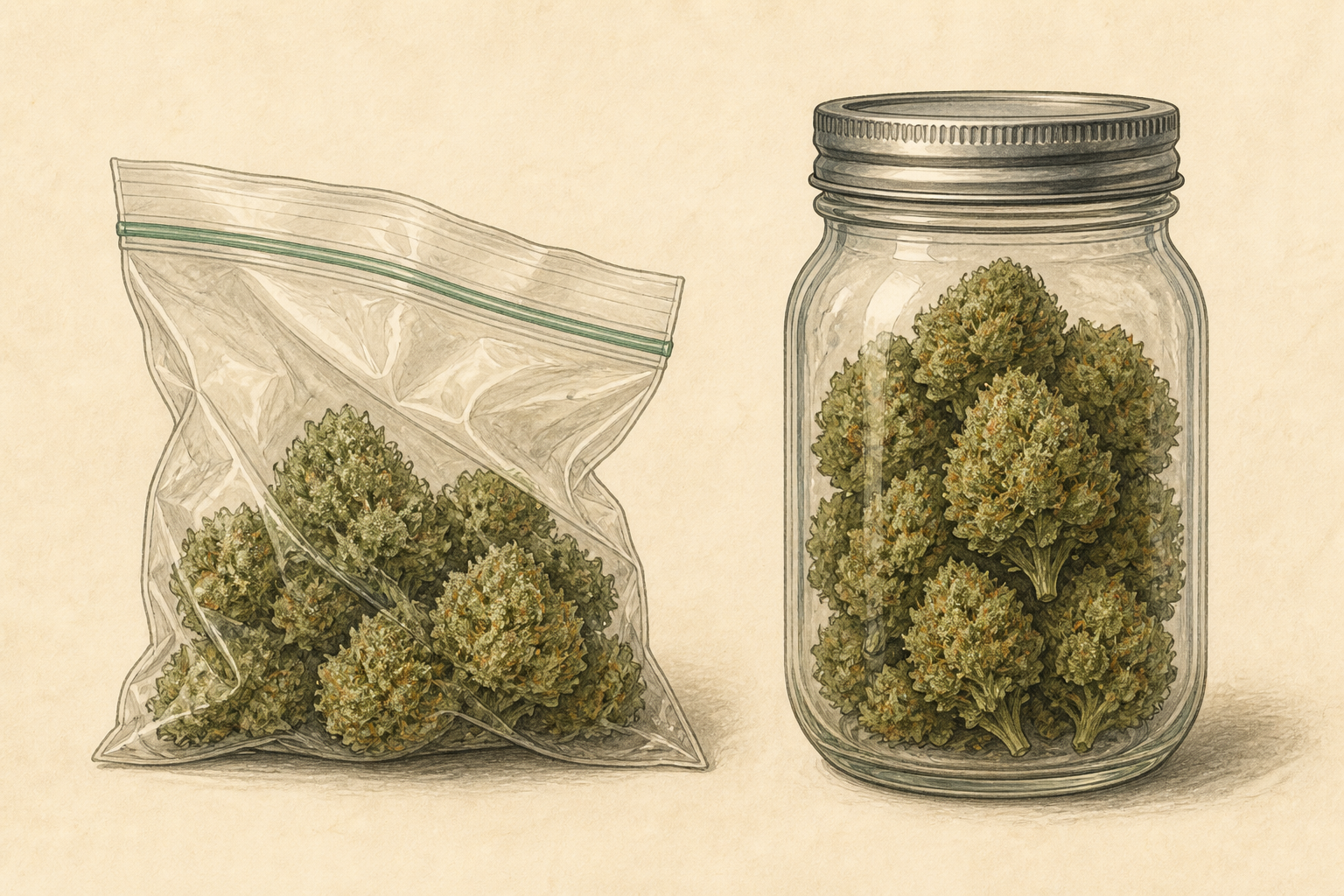
Southern Ohio already has this argument when somebody treats the bag like the jar. One person dumps the eighth into glass on the way in. One person leaves it in the bag because the zip still clicks. Same nugs sit behind two different walls, and only one of those walls is glass. Dump the bag into a jar when you get home.
The jar is a still covered what leaves when you crack the lid. The empty jar is a bigger still covered empty volume while the lid stays on. The grind is the last harvest covered when you break the nug. The fridge is a wet box covered the kitchen. This chapter is the bag you treated like a jar.
How to keep the jar
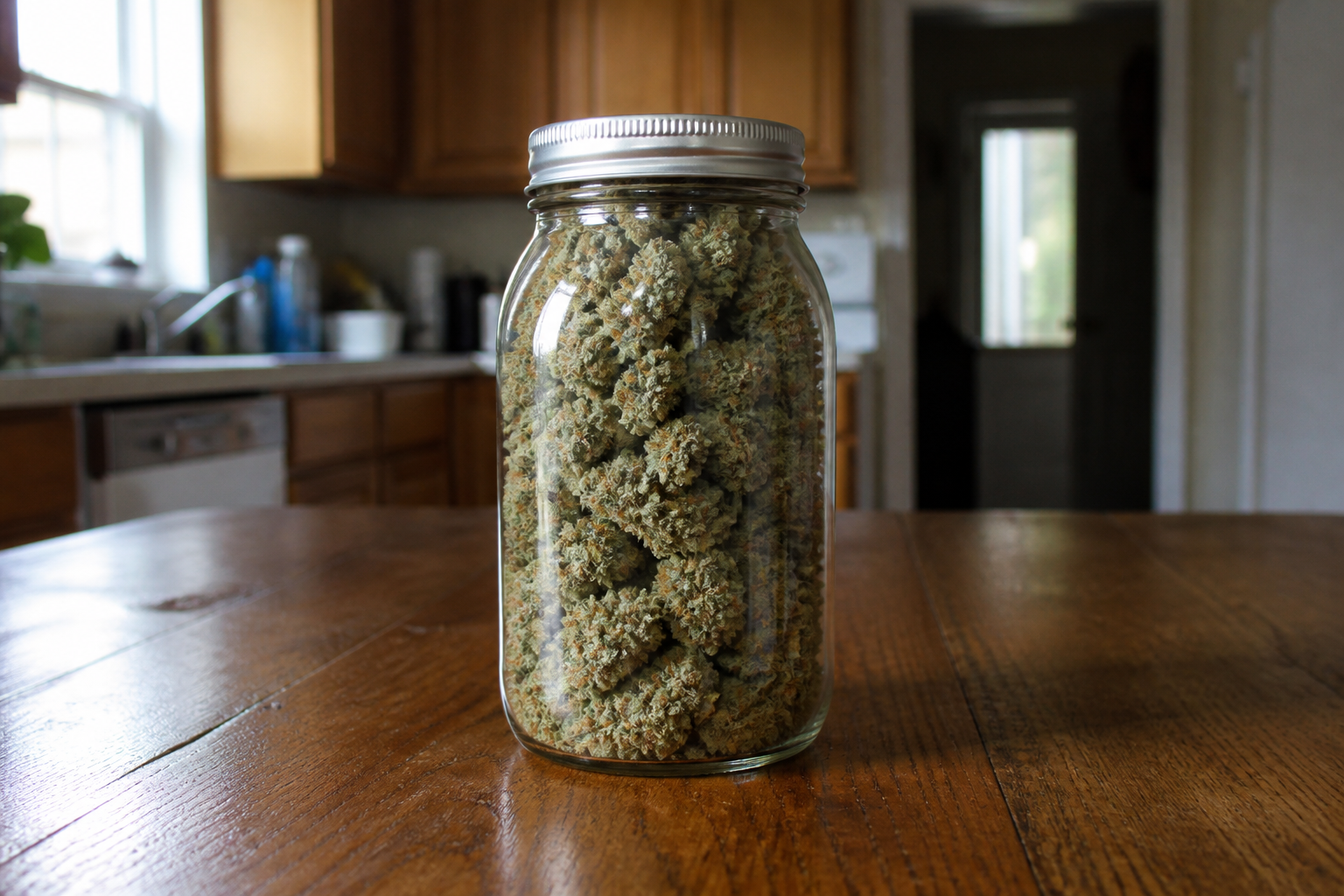
Dump the bag into a jar when you get home. The zip bag is a wall the nose can get through, and glass is not. I am not hanging a loss percent on that move. Just stop storing flower in a film you can smell through.
If the flower is still in the bag, you have not moved it into a jar yet.
They did not trial your zip bag
I did not find a paper that put the same dried flower in a consumer zip bag and a glass jar and published the nose. The “never store in plastic” line you hear on blogs is not a finding I can hang on this tray. This chapter does not give you a loss percent. It gives you the keep: dump the bag when you get home.
People have stored dried inflorescence in closed polyethylene and in glass and published the scent. Spadafora and colleagues used a closed HDPE box, an open tray, and a lid-tight brown glass bottle. They kept those rooms in the dark at 18 °C for six months. After storage, the VOC pattern in the HDPE box tracked the open tray, and glass separated from both. The authors say the HDPE wall lets water and oxygen through, and glass does not. Glass held more of the starting VOC shape than the box or the open air, and the scent still moved in every container (Spadafora et al., 2024, https://doi.org/10.1007/s00216-024-05321-w).
That is a box, not the bag on the table. It is not a zip bag, not a pouch, and not mylar. Different loads and different volumes sat in those three rooms, so I am not pretending the only variable was the wall. I am not writing a terpene-loss percent for your drawer.
Late, and only as physics: polymer films pass gas, water, and aroma, and glass and metal do not. Siracusa reviewed that packaging behavior. There is no flower in that paper, and there is no bag-versus-jar rate. The wall is what fails you. A polyethylene bag is a polymer film, and a glass jar is glass (Siracusa, 2012, https://doi.org/10.1155/2012/302029).
Honesty, because the tray will ask
I did not find a consumer-bag-versus-glass-jar flower paper. Spadafora 2024 is in hand, and it is an HDPE box, not a zip bag. Siracusa 2012 is in hand, and it is packaging physics, not a stash trial. I am not writing a transmission number as science. The weeknight keep is practice sitting on that limit, not a new sample size for the bag in your drawer.
This is 21+ educational writing with no medical claims. It is about how you keep the flower.
Sources
- Spadafora ND, Felletti S, Chenet T, Sirangelo TM, Cescon M, Catani M, De Luca C, Stevanin C, Cavazzini A, Pasti L. The influence of drying and storage conditions on the volatilome and cannabinoid content of Cannabis sativa L. inflorescences. Analytical and Bioanalytical Chemistry. 2024. HDPE box versus brown glass bottle versus open tray; six months at 18 °C; VOC pattern in HDPE tracked the open tray; glass separated; not a zip-bag trial. https://doi.org/10.1007/s00216-024-05321-w
- Siracusa V. Food packaging permeability behaviour: a report. International Journal of Polymer Science. 2012;2012:302029. Polymer films pass gas, water, and aroma; glass and metal do not; no flower; physics only. https://doi.org/10.1155/2012/302029
Flagged / not used as numbers: any bag-versus-jar loss percent (none found); treating Spadafora as a zip-bag trial; quoting polymer-to-polymer tables as a bag n; OTR, WVTR, or terpene-transmission figures; hanging this chapter on the lid (Chapter 1) or the humidity pack (Chapter 5); treating MacLaughlin steel cans as this bag.
Series note
This is chapter 12 of a CincyCannaDash quality library. The still still runs, and the bag is not a jar. Next is not locked.
The live board is today's menu. Dated lab reports sit next to the lots, and areas lists the Southern Ohio towns we already serve. 21+. (513) 986-5438.
More notes
- The lid ring is the seal
- The tape is the memory
- The working jar is the small one
- The empty jar is a bigger still
- The grind is the last harvest
- Two OGs, same family
- The fridge is a wet box
- Light is the faster insult
- The dash is a kiln
- The pack is not a cure
- The freezer is not a time machine
- Amber is senescence
- The name is not the plant
- How pick up and delivery works
- How to read a lab report
- Your cannabis jar is a still