
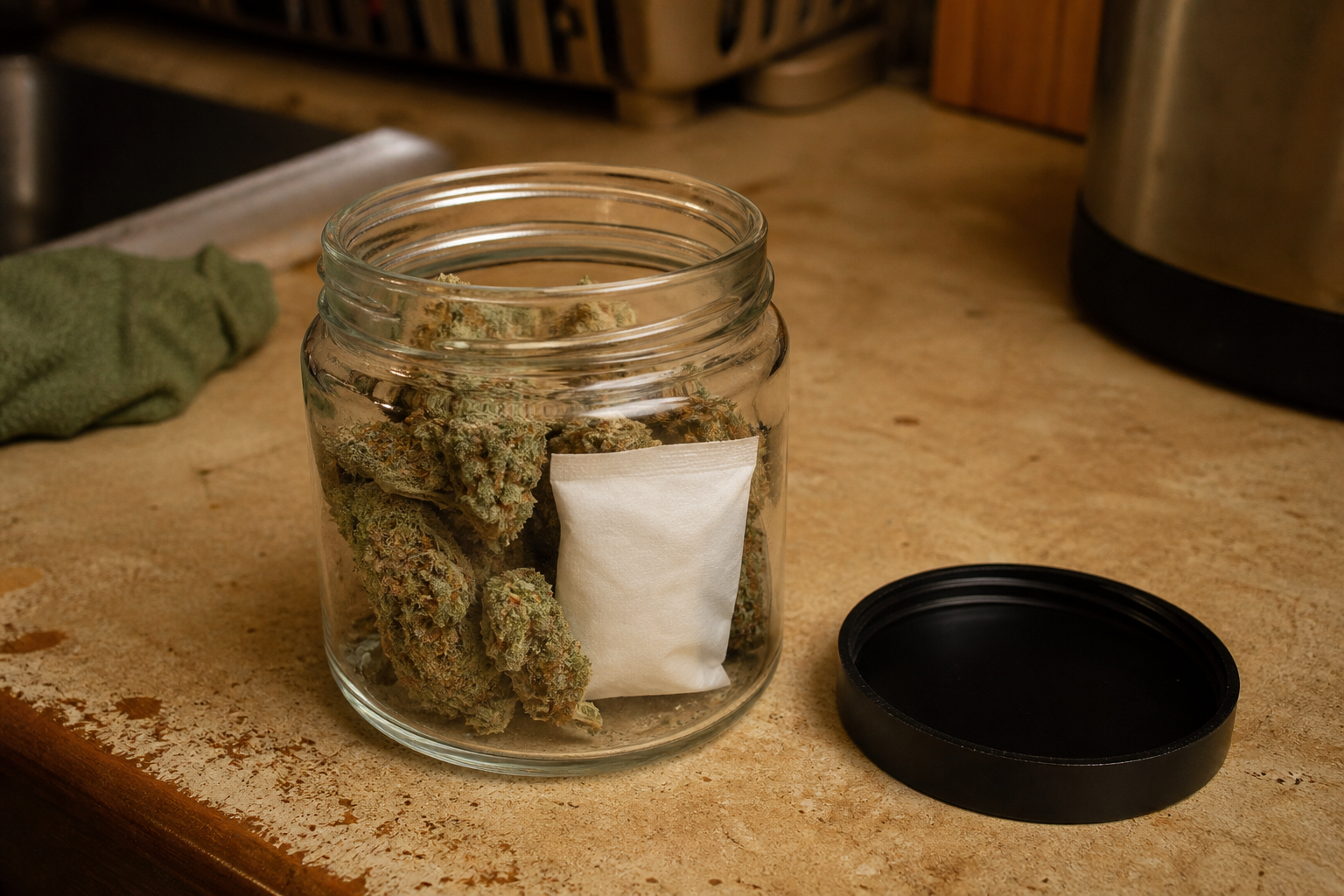
You crack a lid that has a little white pack stuffed in with the nugs. Somebody told you 62 was the number. The flower feels less like hay. It does not snap. You take that as a cure. The room still does not fill the way it did the week the jar was new. The herb is still there. The gas is thinner. The pack held the water. It did not pause the clock on the nose.
Somebody runs a pack in every jar like a religion. Somebody swears packs ruin the smell. Somebody throws a pack into a wet eighth and calls it fixed. Same batch. Three different rooms. The keep is simpler than the fight.
The jar is a still was what leaves when you crack the lid. Amber is senescence was the balloon that feeds it. The name is not the plant was the rumor on the sticker. The freezer is not a time machine was the sealed jar that never moved and still changed. This chapter is the pack you treated like a time machine for moisture.
How to keep the jar
Leave it whole. Keep it cool and dark. If the flower is actually wet, dry it before you seal it. If it is already in a safe moisture band, a salt-based pack can hold it there. That is the keep.
A pack is a humidity tool. It is not a terpene vault. It is not a substitute for the week you were supposed to let the jar finish.
The band is a spec, not a terpene trial
People talk about 58 and 62 like those numbers came out of a flower study that watched the nose. They did not. The open document that actually names a water-activity band for dry flower is a specification. It is a recommended range for safe, useful storage, written so a sealed jar does not grow mold and does not shatter when you handle it.
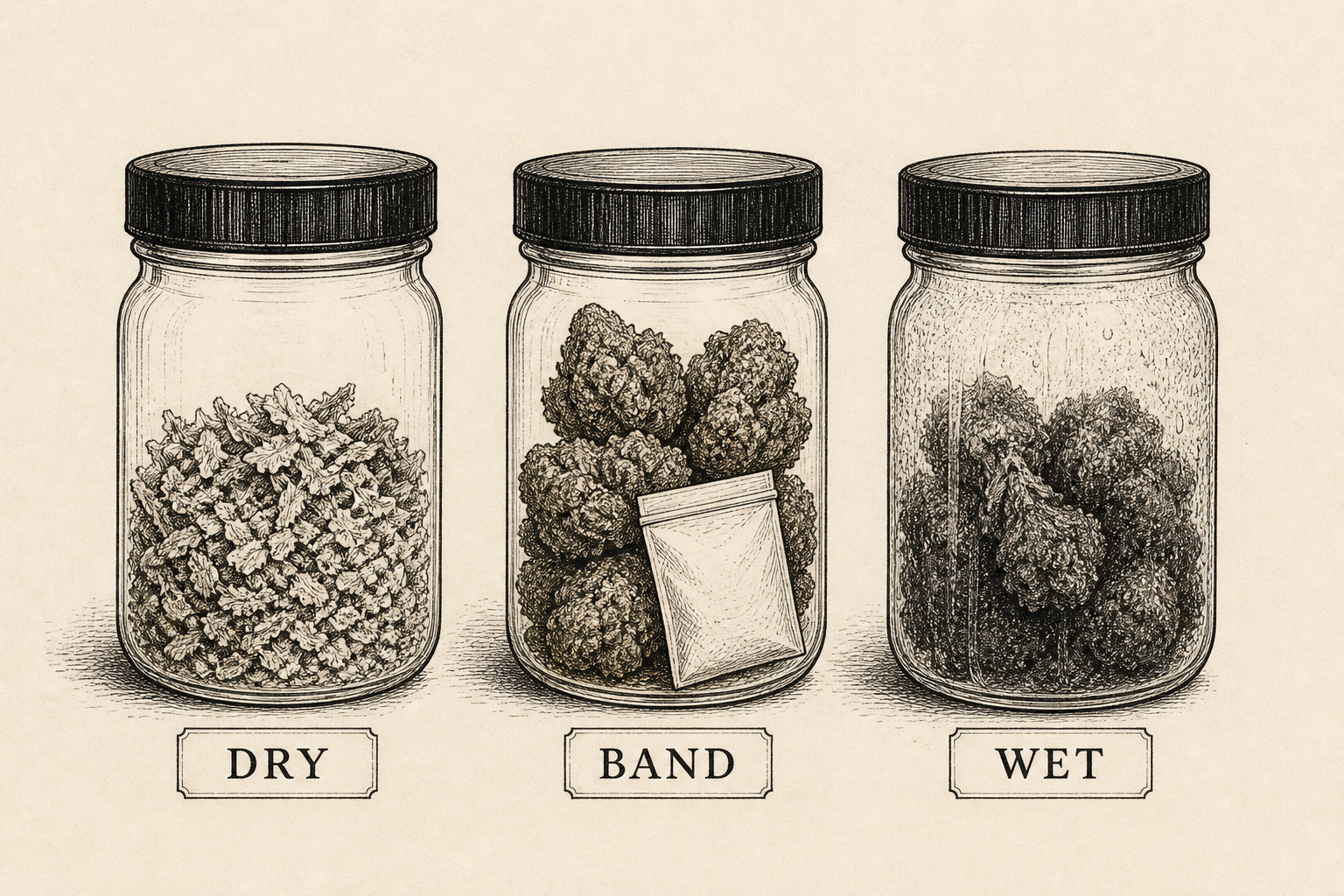
ASTM D8197-22 sets that band at water activity 0.55 to 0.65. Below 0.65 is the mold line they wrote. Above 0.55 is the breakage line they wrote. If water activity is over 0.68, the spec says dry the flower further until it is in the band. If it is under 0.68, a salt-based humidity sachet designed for 0.55 to 0.65 can pull the sealed jar into that range. The measurement practice sits next door as ASTM D8196. That is how you read aw. It is not a stash-room experiment.
The committee told you how to keep the flower from going moldy or turning to dust. They did not publish a terpene table. They did not crown 62. They did not say the pack puts a cure back into an eighth you rushed.
A narrative review of drying and extraction points at the same band. Lazarjani, Young, Kebede, and Seyfoddin (2021) cite the water-activity practice and say drying that holds flower between 0.55 and 0.65 aw cuts mold risk while you try to keep quality. They also say the thing Southern Ohio already feels: curing matters, and the academic shelf on a finished jar is thin. That review is not a pack trial.
If the jar is wet, dry it
This is the keep people skip. The spec's wet line is 0.68. Over that, you dry the flower. You do not bury a pack in a foggy jar and call it handled. A salt pack is written as a way to bring a jar that is already under 0.68 into the 0.55–0.65 band, and to hold it there. It is not a towel for a wet eighth.
You do not need a lab meter to see the bad version. Glass sweats. The nugs clump. The lid smells like a basement. That jar wants air and time, not another packet. The other bad version is the hay jar. Nugs that powder when you pinch them. The pack can put water back into that one. That is the breakage side of the spec, the 0.55 floor, written so routine handling does not wreck the flower.
Most of us do not run ASTM D8196 on the kitchen counter. Say that out loud. A cheap hygrometer in the lid is not the practice. Use your hands and the glass, then be honest about what the pack can do. It can hold moisture. It cannot tell you the terpene panel held.
The nose still moves
Chapter 4 already sat with the one open flower trial that watched acids and terpenes in storage. Terpenes moved first. Temperature and grind were the knobs in that design. Moisture sat near nine percent and did not wander with the rooms they tested. They did not drop a humidity pack in the bottle (Milay, Berman, Shapira, Guberman, and Meiri, 2020).
So do not walk out of this chapter thinking a pack cancels Chapter 4. Whole nugs in the cool dark still beat a Sunday grind on a warm shelf. A pack on top of a bad room is still a bad room with damper nugs. The pack is a moisture tool. Use it that way.
Oven-dry papers from the seventies already showed the other insult: heat and time take cannabinoids off the leaf while you are trying to dry it. That is process, not a pack study, and it is why you do not fix a wet jar in a hot oven and call it science (Coffman and Gentner, 1974, as discussed in Lazarjani et al., 2021). Slow and cool is still the keep for drying. The pack comes after.
What the pack is for
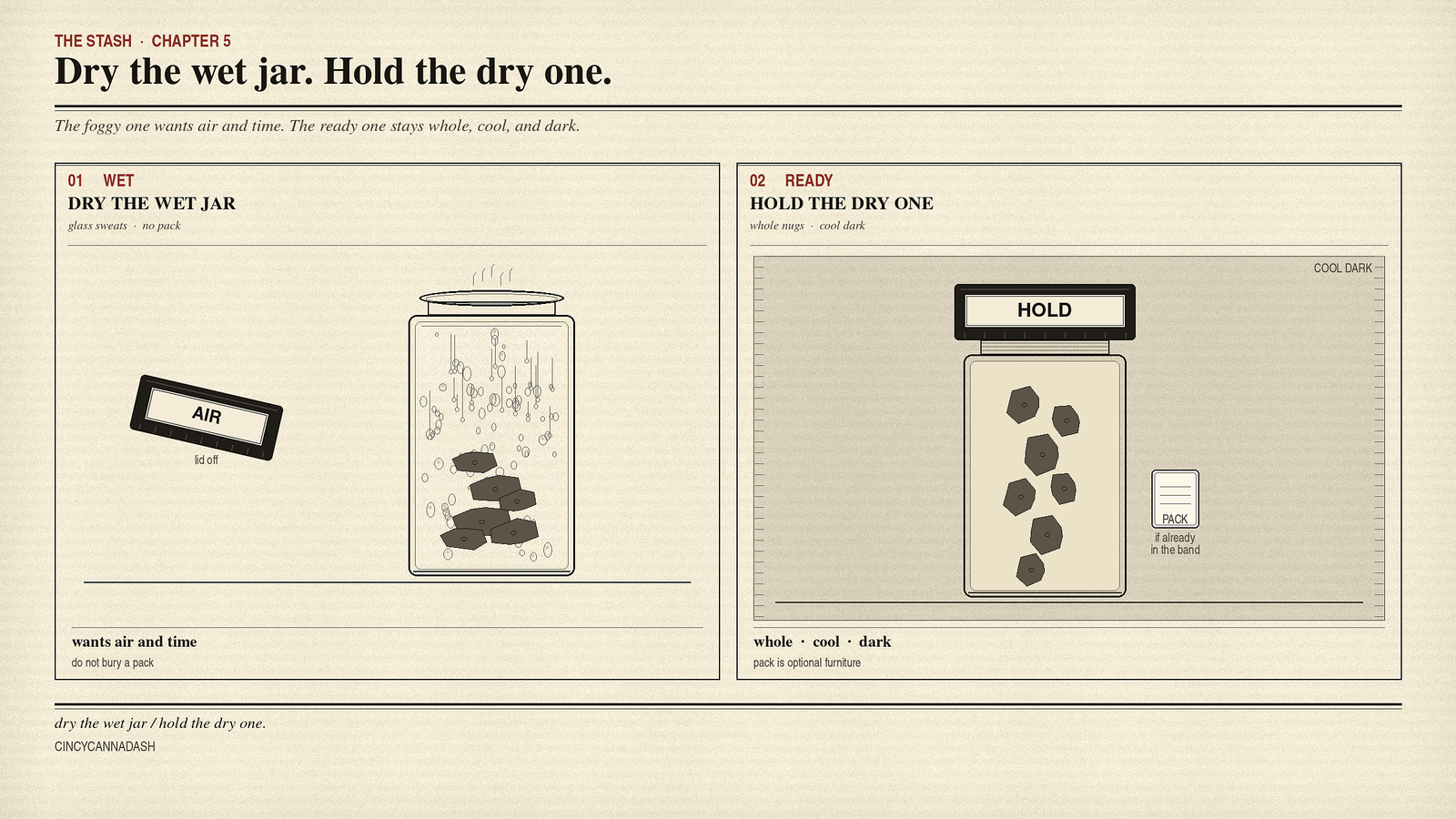
Use a pack when the jar is too dry and the nugs are getting brittle, or when you already landed in the band and you want the headspace to stay there. Skip the pack when the glass is wet. Skip the story that the pack is a cure. A cure is time, darkness, and a jar you actually burp because the flower is still finishing. The review authors said there is not enough academic work on that last step. They are right. Do not fill the hole with a packet.
Southern Ohio already knows the keep when it is said like a person. Whole nugs. Cool. Dark. Dry the wet jar. Hold the dry one. Crack it when you mean to. The pack is optional furniture in that room. It is not the room.
I did not read the paywalled full ASTM PDF. The band, the 0.68 dry-it-first line, and the salt-sachet language are from the public specification abstract. I am not inventing extra clauses.
21+. Educational. No medical claims. This is about how you keep the flower.
Sources
- ASTM D8197-22. Standard Specification for Maintaining Acceptable Water Activity (aw) Range (0.55 to 0.65) for Dried Cannabis Flowers. Public abstract this pass. Band 0.55–0.65. Dry further if aw is over 0.68. Salt-based sachet language for jars already under 0.68. Not a terpene trial. Not a crown for 62.
- ASTM D8196. Standard Practice for Determination of Water Activity (aw) in Cannabis Flower. Measurement practice, not a stash-room experiment.
- Lazarjani HA, Young O, Kebede L, Seyfoddin A. Processing and extraction methods of medicinal cannabis: a narrative review. Journal of Cannabis Research. 2021. Cites the water-activity band. Curing matters. Academic shelf on a finished jar is thin. Not a pack trial.
- Milay L, Berman P, Shapira A, Guberman O, Meiri D. Metabolic profiling of cannabis secondary metabolites for evaluation of optimal postharvest storage conditions. Frontiers in Plant Science. 2020;11:583605. Chapter 4 already owns this. No humidity pack in the bottle. Terpenes moved first. Moisture sat near nine percent. https://doi.org/10.3389/fpls.2020.583605
- Coffman CB, Gentner WA. 1974. As discussed in Lazarjani et al., 2021. Oven-dry process paper, not a pack study.
Flagged / not used as numbers: any terpene table from ASTM D8197 (none); crowning 58 or 62 as a nose finding; treating a pack as a cure; inventing extra clauses from a paywalled ASTM PDF; hanging Milay as a pack trial.
Series note
This is chapter 5 of a CincyCannaDash quality library. The still runs. The pack is not a cure. Next is not locked.
The live board is today's menu. Dated lab reports sit next to the lots, and areas lists the Southern Ohio towns we already serve. 21+. (513) 986-5438.
More notes
- The lid ring is the seal
- The tape is the memory
- The working jar is the small one
- The bag is not a jar
- The empty jar is a bigger still
- The grind is the last harvest
- Two OGs, same family
- The fridge is a wet box
- Light is the faster insult
- The dash is a kiln
- The freezer is not a time machine
- Amber is senescence
- The name is not the plant
- How pick up and delivery works
- How to read a lab report
- Your cannabis jar is a still