
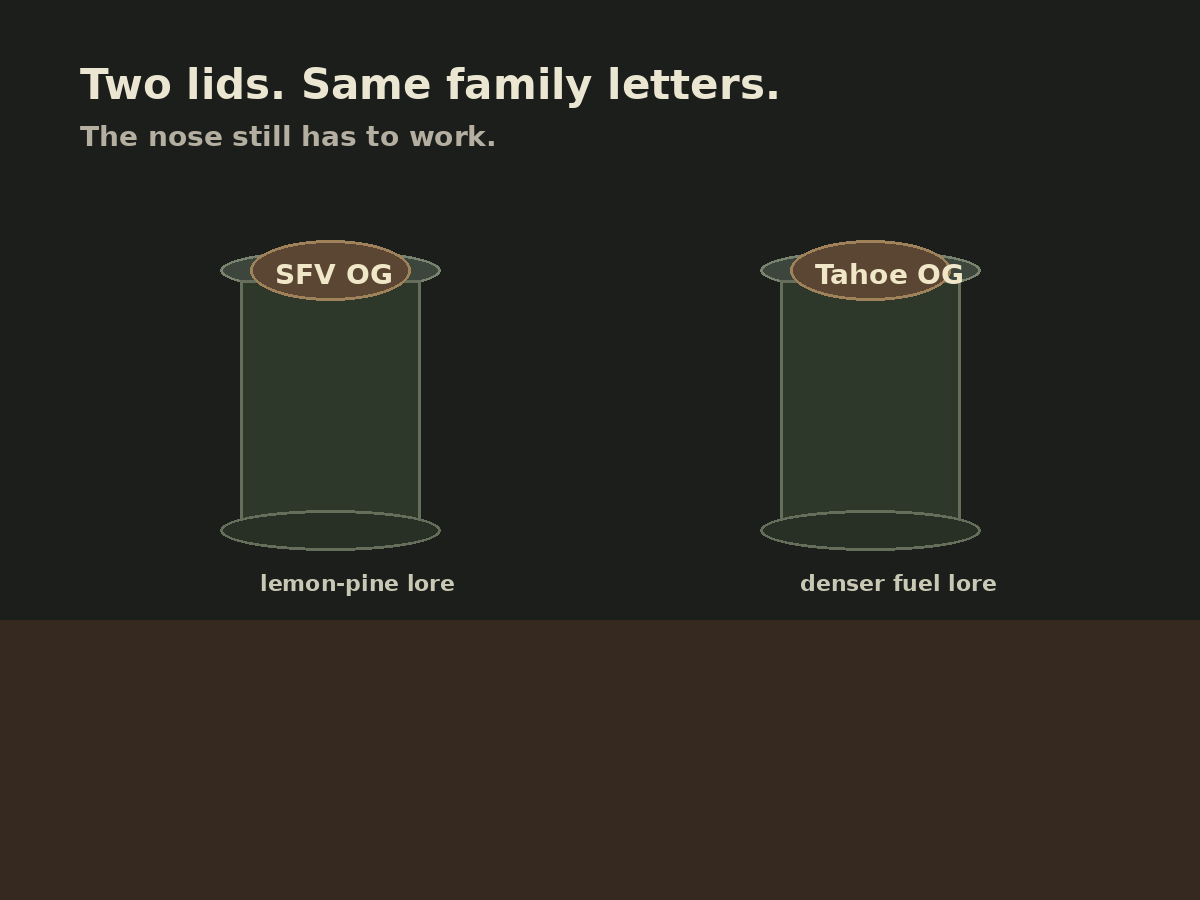
You put two eighths on the table because both lids carried the letters O and G. One sticker said SFV OG. The other said Tahoe OG. A friend already told you which cut is brighter and which sits heavier. A forum post already said they are the same plant with different marketing. When you crack both lids, the room does not settle that argument for free.
Southern Ohio runs this argument every week. One person insists SFV is the lemon-pine gas cut, another insists Tahoe is the denser fuel cut, and a third person buys whichever OG smells loudest that day without ever reading the middle word on the lid. Do not crown a winner from the sticker. Put both jars on the tray and learn how two famous OG names can share a family and still disagree once they are open.
The jar is a still covered what leaves when you open flower. The name is not the plant covered why a cultivar label is a rumor until the chemistry shows up. The fridge is a wet box covered a kitchen mistake. This chapter puts SFV OG and Tahoe OG on the same tray and walks through what the paper can say, what culture keeps repeating, and what you should do with both jars tonight.
How to compare them without trusting the lid alone
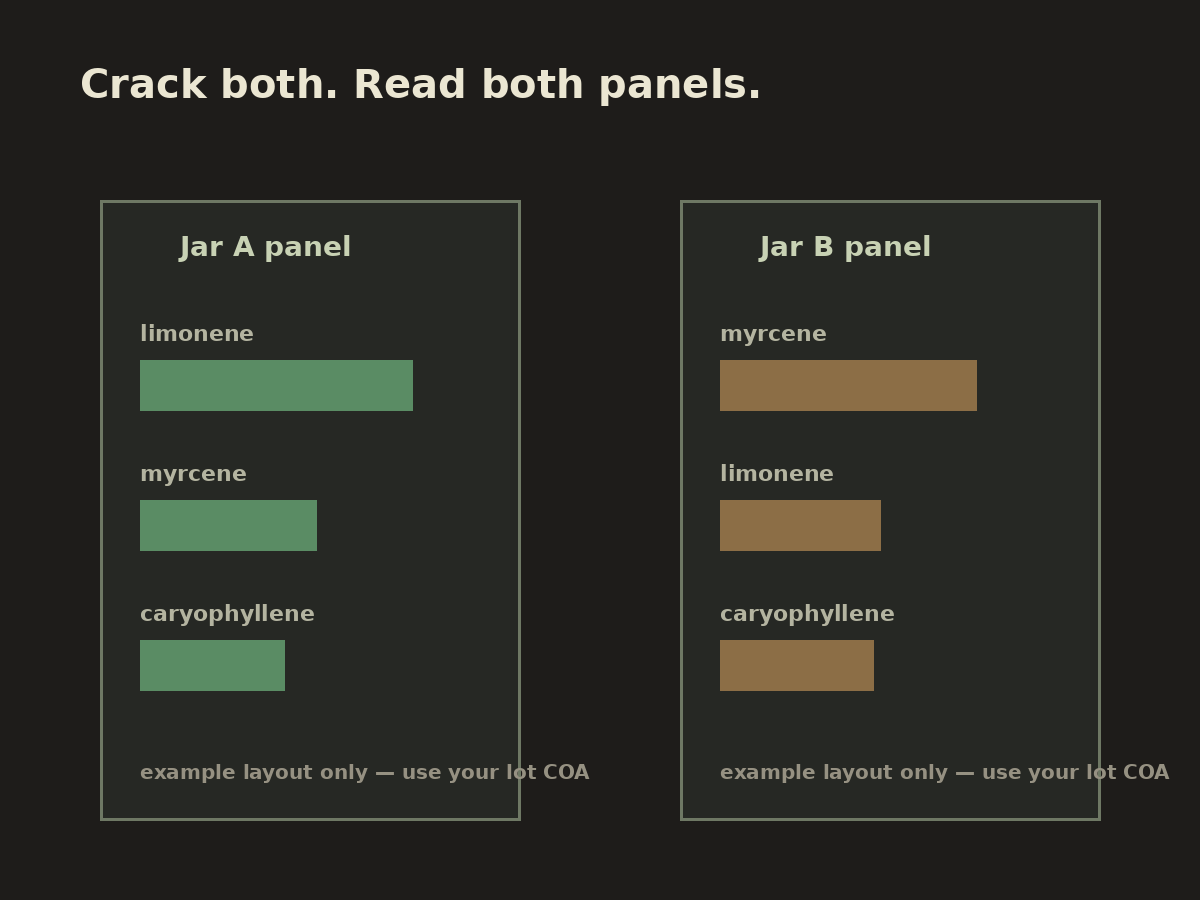
Start with the flower, not the PDF. Open the SFV jar and write down what actually hits your nose in ordinary words, then open the Tahoe jar and do the same thing before you look at either certificate. After that, open the terpene panel on each lot and check whether the top two or three terpenes match the story your nose just told.
If the SFV lot leads with limonene and supports pine-facing notes, that bag is lining up with the lemon-pine gas story people keep attaching to SFV. If the Tahoe lot leads with denser earth and fuel-facing notes on this particular harvest, that bag is lining up with the heavier Tahoe story. If the panels reverse the folklore, trust the panels for the bags in your hand, because the sticker only told you which family rumor you bought and the panel tells you what chemistry showed up in this lot.
Chapter 3 already said the name on the lid is a starting rumor, and this chapter does not take that back. It simply puts two famous OG rumors next to each other and asks you to finish the compare like a person who actually opens jars.
What people usually mean by SFV versus Tahoe
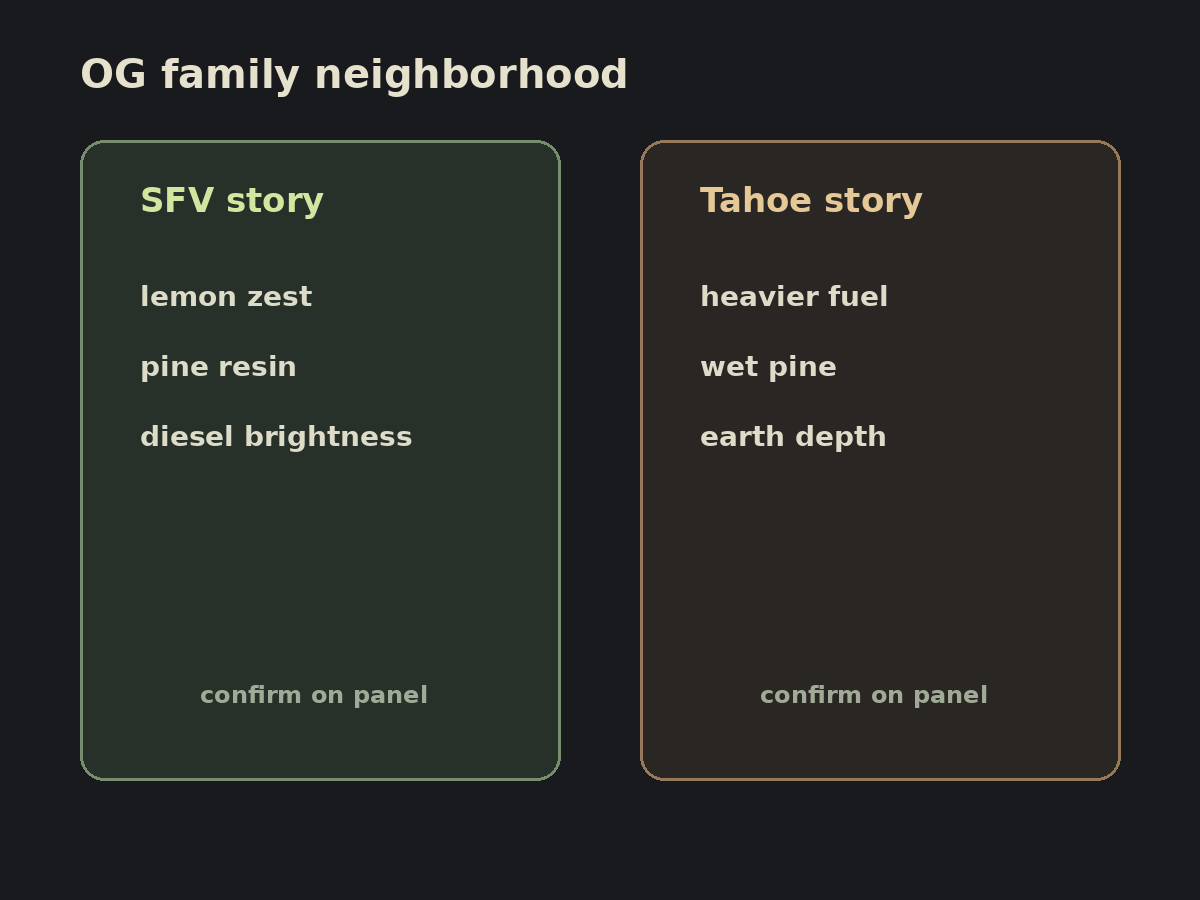
In breeder and market talk, SFV OG is the San Fernando Valley selection that people describe as lemon zest, pine resin, and diesel brightness, while Tahoe OG is the Lake Tahoe–linked selection that people describe as heavier fuel, wet pine, and earth. That split is useful as culture around the family. It is not a peer-reviewed recipe that locks limonene onto every SFV bag or myrcene onto every Tahoe bag, and I did not invent percentages for either name.
If your SFV smells like lemon-pine gas and your Tahoe smells denser and more fuel-heavy, you are hearing that folklore land on real flower. If both jars smell nearly the same, you are hearing the Chapter 3 lesson again: the middle word on an OG lid does not guarantee a private chemotype. Either way, what makes each jar unique tonight is the order of terpenes on that lot’s panel plus what actually leaves when you crack the lid.
What a peer-reviewed flower set actually showed
In 2015, Elzinga, Fischedick, Podkolinski, and Raber published a principal component analysis of cannabinoids and terpenes across hundreds of California medicinal flower lots that patients had submitted for testing (https://doi.org/10.4172/2329-6836.1000181). SFV OG appeared twelve times in that table and Tahoe OG appeared fourteen times. Both names were tagged as hybrids, and both landed inside the broader OG group next to names such as Fire OG, Larry OG, and Skywalker OG.
When the authors split OG-labeled flower from Kush-labeled flower, the OG neighborhood was characterized mainly by α-terpineol, fenchol, limonene, camphene, terpinolene, and linalool, while the Kush neighborhood leaned toward trans-ocimene, guaiol, β-eudesmol, myrcene, and α-pinene. The groups separated with overlap, and the paper described a continuum of composition rather than sealed chemical boxes.
THCmax in that same table averaged 18.9 percent for SFV OG, with a range from 14.1 percent to 23.3 percent. Tahoe OG averaged 17.5 percent, with a range from 13.2 percent to 21.6 percent, and those ranges overlap hard. Even plain OG Kush swung from 4.9 percent to 25.0 percent across twenty-eight lots in the same dataset. Strain name was a poor potency predictor in that paper, and replicates of a single name often failed to cluster tightly.
The honest scientific line is that both names sat in the same OG chemical neighborhood in the one peer-reviewed table that lists them side by side, while THC and lot chemistry still wandered. Later commercial clustering work keeps finding a small number of terpene chemotypes underneath a huge pile of retail names (Smith et al., 2022, https://doi.org/10.1371/journal.pone.0267498). Genetic labelling work has also found that pairs carrying the same cultivar name can be as distant as pairs carrying different names (https://doi.org/10.1038/s41477-021-01003-y), which is Chapter 3 again wearing an OG hoodie.
What one lab paper measured on Tahoe lots
Fischedick later quantified sixteen terpenoids across high-THC cultivars from one California medical retailer and reported means with standard deviations in milligrams per gram (Fischedick, 2017, https://doi.org/10.1089/can.2016.0040). Tahoe Og Kush appeared with five lots in that table. Myrcene averaged 8.8 mg/g with a wide swing of plus or minus 4.6, limonene averaged 6.8 mg/g plus or minus 1.3, and β-caryophyllene averaged 4.6 mg/g plus or minus 0.8. Linalool, endo-fenchyl alcohol, and α-terpineol showed up as the alcohol-substituted markers that helped place Tahoe in an “Og Kush” terpene class where limonene and myrcene sit near each other rather than in a limonene-heavy subclass.
That wide myrcene standard deviation is the teaching point: even under one retailer label, Tahoe lots swung. The numbers are useful education for the Tahoe side of the tray, and they are still not a forever formula for every Tahoe sticker in Southern Ohio. SFV did not appear in that cultivar table, so this chapter will not invent matching SFV averages. Use the Tahoe numbers to understand what a published multi-lot OG pattern can look like, and use your own lot panels to decide what you bought tonight.
What this chapter will not pretend
I do not have a CincyCannaDash trial that grew SFV and Tahoe in one room and published the delta. The 2015 numbers come from California submitter lots with reported names, and the 2017 Tahoe means come from five lots at one retailer, so neither set is a promise about tomorrow’s Southern Ohio board. If today’s menu carries an SFV or a Tahoe, that certificate is a snapshot of that lot rather than a forever formula for the name.
This chapter does not pick a winner between the two lids. Both names share an OG neighborhood in the paper that lists them together. Market talk still splits a brighter nose from a denser nose. One published Tahoe table shows a near 1:1 limonene-to-myrcene pattern with a lot of swing. Uniqueness still lives in the jar you crack and the panel you read.
This is 21+ educational writing with no medical claims. It is about how you compare two famous OG lids with the jar and the panel.
Sources
- Elzinga S, Fischedick J, Podkolinski R, Raber JC. Cannabinoids and Terpenes as Chemotaxonomic Markers in Cannabis. Natural Products Chemistry & Research. 2015;3:181. SFV OG n=12; Tahoe OG n=14; OG versus Kush PCA loadings. https://doi.org/10.4172/2329-6836.1000181
- Fischedick JT. Identification of Terpenoid Chemotypes Among High (−)-trans-Δ9-THC-Producing Cannabis sativa L. Cultivars. Cannabis and Cannabinoid Research. 2017;2(1):34-47. Tahoe Og Kush n=5 terpene means ± SD in mg/g. https://doi.org/10.1089/can.2016.0040
- Smith CJ, et al. The phytochemical diversity of commercial Cannabis in the United States. PLOS One. 2022. Terpene chemotype clusters under many retail names. https://doi.org/10.1371/journal.pone.0267498
- Watts S, et al. Cannabis labelling is associated with genetic variation in terpene synthase genes. Nature Plants. 2021. Same-name pairs can be as distant as different-name pairs. https://doi.org/10.1038/s41477-021-01003-y
Flagged / not used as numbers: Leafly or nursery “typical” terpene ranges presented as science; indica or sativa as chemistry for either OG; medical effects; invented SFV limonene or myrcene means; treating Fischedick Tahoe means as a forever Southern Ohio formula; any claim that the 2015 PCA proved SFV and Tahoe are opposite chemotypes.
Series note
This is chapter 9 of a CincyCannaDash quality library. The still still runs, and the lid is still a rumor. Two OGs can share a family and still disagree once both jars are open. Next is not locked.
The live board is today's menu. Dated lab reports sit next to the lots, and areas lists the Southern Ohio towns we already serve. 21+. (513) 986-5438.