
Two lids on the counter. Same printed name. You crack the first and it is pine, clean, almost solvent-bright. You crack the second and it is cheese and skunk and a chemical bite that does not live in that first jar at all. The stickers match. The rooms do not.
Anybody who actually compares jars in Southern Ohio has done this. You bought the name you liked last time. You got a different plant. Not a quieter version of the same kind. The jar is a still, and the loud fraction leaves first. Not a bag of collapsed balloons. Amber is senescence, not a harvest dial. This is two nugs wearing the same rumor and smelling like they never met.
The word on the lid is "strain." That is the market word, the one the printer had. Over a tray nobody is testing a personality. They are testing whether two bags that share a sticker share a plant. From here on I am just going to call it a name.
They often do not. They also often do. I am not dropping that second sentence to make a cleaner story.
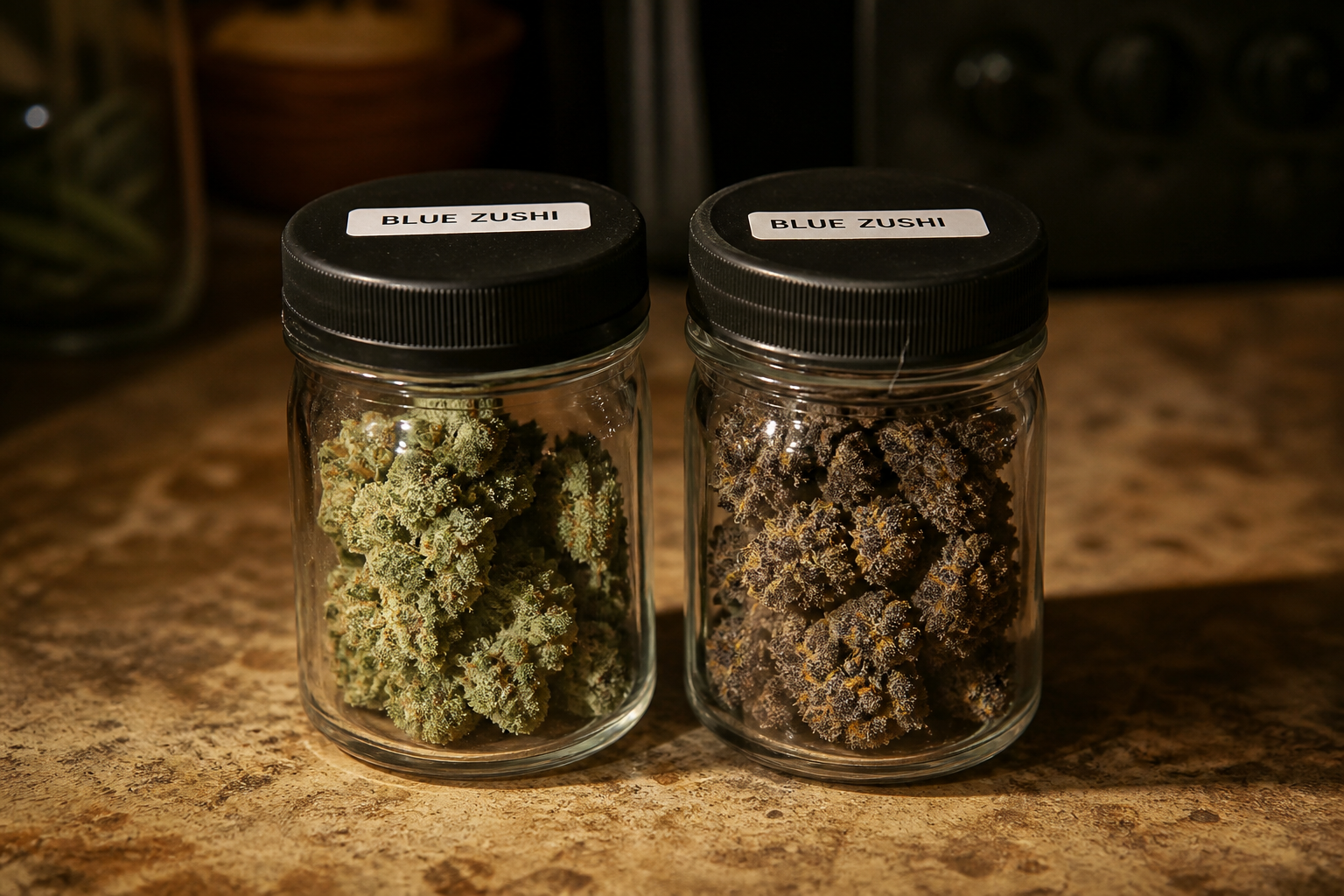
The lid is a rumor. The panel is the plant.
A name can be a real plant. Hold the genetics still, grow the cuts in the same room, and chemistry can tell the varieties apart. Eleven cultivars, same conditions, each one separable from the others by the combined cannabinoid-and-terpene fingerprint. That work is a decade and a half old, and it is the opposite of "names are meaningless." When the plant is actually the plant, a variety has a fingerprint (Fischedick, Hazekamp, Erkelens, Choi, and Verpoorte, 2010).
Buy the name in different shops and the fingerprint wanders.
The lid is a starting rumor. The COA terpene row plus the cannabinoid row is the identity. People who already smell the jar before they commit already live this. They just keep getting talked out of it by a number and a nickname.
THC is not the ID
Amnesia and White Widow are two lids everybody already knows. Buy them around Dutch coffee shops, a gram at a time, two visits a couple of months apart, and you get what a traveling name actually delivers: a pile of jars that are mostly two plants, and a pile of scatter inside each name.
Mean THC did not separate them. Amnesia sat at 16.75 percent. White Widow sat at 15.95 percent. The authors said it out loud: no significant difference. The split lived in the terpenes and the minor cannabinoids. Amnesia ran higher in terpinolene, β-caryophyllene, THCV, CBC, CBG. White Widow ran higher in myrcene and α-pinene, plus a set of sesquiterpene alcohols (guaiol, the eudesmols, α-bisabolol) that did not even show up in the Amnesia set (Hazekamp and Fischedick, 2012).
Three of those purchased samples chemically matched the other name. Two sold as White Widow looked like Amnesia. One sold as Amnesia looked like White Widow. The authors assumed mix-up and dropped those three from the diversity stats. They also wrote the opposite possibility: if those were "true" specimens, within-name scatter would have been even larger. That is not a fraud rate, and it is not an Ohio number. It is three Dutch coffee-shop lids that chemically matched the other name. After they dropped the three, the remaining Amnesia still clustered with Amnesia. Names can be chemically real as group averages. One jar is not a group average.
Shop-to-shop, fourteen of the twenty-eight compounds they tracked wandered more than 25 percent relative standard deviation. Pharmacy batches of the same Dutch medical varieties, same method, stayed tighter. Controlled grow holds a fingerprint. The street name does not promise you that grow.
High-THC flower that all looks "the same" on the cannabinoid line still splits by terpene. One California shop, a year of high-THC lots, a handful of terpene classes: some named cultivars sat in a class, others looked like a continuum. Classification worked when they had many samples of a class. One jar is not a class (Fischedick, 2017).
A lot of names collapse into a few terpene shapes
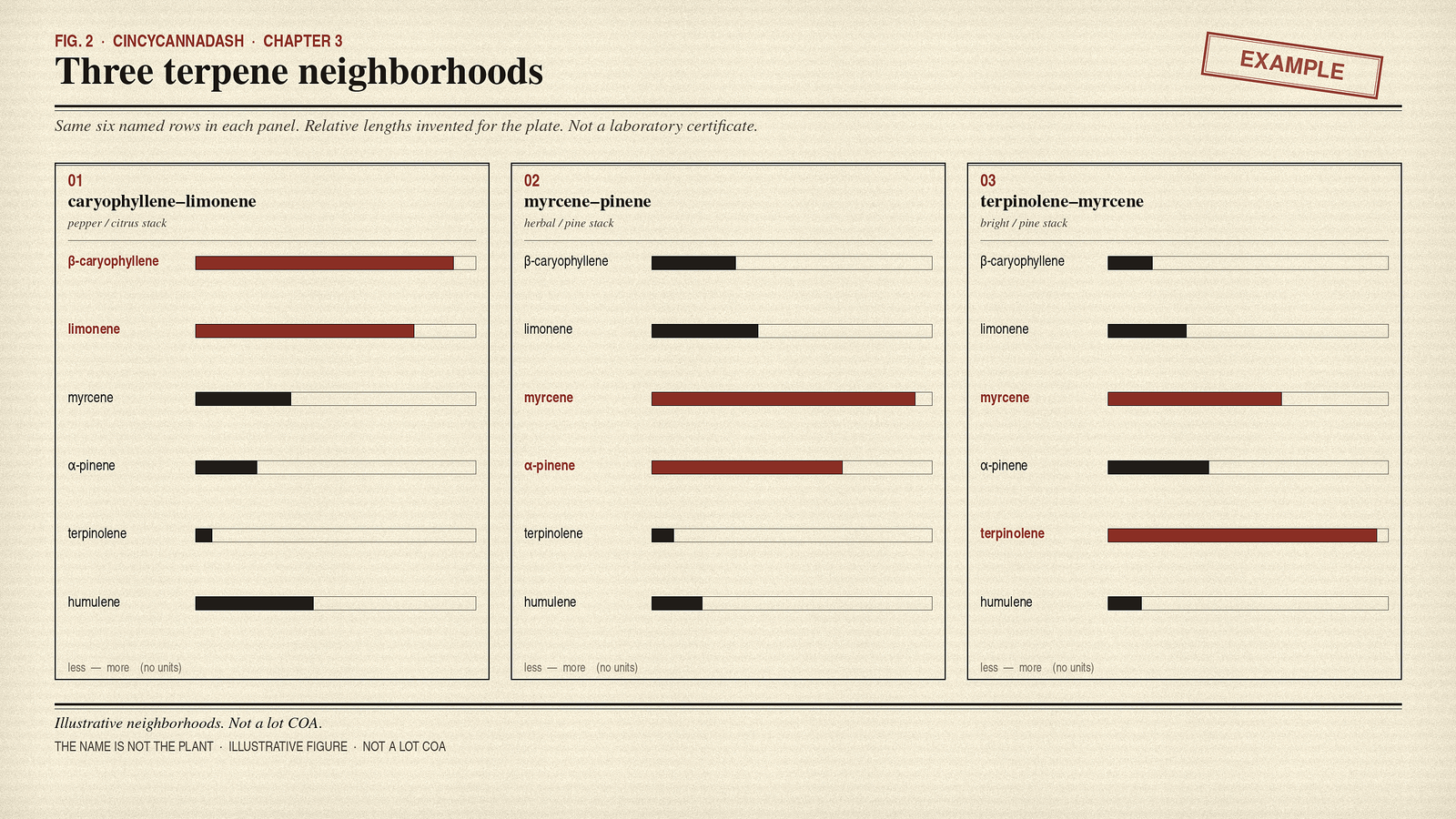
You already know this if you have ever lined up COAs. The lid says a story. The terpene row says caryophyllene and limonene, or myrcene and pinene, or terpinolene and myrcene. Those three shapes keep showing up. The names do not.
A Nevada lab, looking at cleaned-up cultivar names across a year and a half of flower tests, landed on three terpene clusters under 396 names. The authors' own line is the useful one: the names overestimate the diversity and do not tell you the chemistry (Reimann-Philipp et al., 2020). That is not a same-name mismatch table. They collapsed the names. They did not publish "this lid failed that lid." What they published is simpler: a lot of stickers sitting on a few shapes.
The U.S. commercial set is the same picture with more states in it. THC-dominant flower keeps falling into those three terpene neighborhoods: high caryophyllene–limonene, high myrcene–pinene, high terpinolene–myrcene. Some names lean a neighborhood. Purple Punch sat mostly in the first. Tangie was loose. Even the tight names were not a hundred percent. Names beat a random shuffle, and they beat the indica / hybrid / sativa sticker, and they still do not replace a terpene row (Smith, Vergara, Keegan, and Jikomes, 2022).
Keep that last part on the tray. A name is not worthless. A name is not a chemotype.
In a big Dutch set, supplier-labeled Sativa and Indica did not differ in mean THC or CBD. Terpenes did the work, as group averages (bergamotene and terpinolene on one side, myrcene and the eudesmols on the other), and even that is a pile, not a promise on the jar in your hand (Hazekamp, Tejkalová, and Papadimitriou, 2016). Washington flower matched to those same three marketing words barely moved THC at all. The category explained about one and a half percent of the THC variance (Jikomes and Zoorob, 2018). Indica and sativa are not empty folklore. They are a weak label. If anything real is in the word, it is a terpene story, and a terpene story is sitting on the COA if you look.
The name is not a genotype either
You can smell a mismatch. A Colorado panel did. Four names, retail flower, same sticker across shops. Genetic outliers showed up inside the names the way they had in an earlier buy. When people smelled those outliers blind, the odd jars sat outside the consensus aroma of that name. More cheese and wood on an OG Kush that did not belong. More pungent and skunk on a Blue Dream that did not belong. Even genetically matching Blue Dream samples did not all land in the same aroma cluster. Grow, harvest, and the jar as still will do that without anyone swapping a lid (Schwabe, Naibauer, McGlaughlin, and Gilbert, 2022).
The genetics under the sticker are messier than a pedigree and simpler than a scam. Across three states, most of the thirty names in one consumer-style buy contained at least one genetic outlier. Only four names were consistent in every sample. After the obvious odd jars were pulled out, many names still looked like relatives (first-order relatedness, a genetic core). All eight names that online databases call clone-only still had at least one divergent sample. The authors could not locate the error. Mis-ID, mislabel, misspelling, relabel, unstable seed: they listed all of those and proved none of them as a chain (Schwabe and McGlaughlin, 2019).
In six of seventeen same-name pairs, the sample was genetically closer to a different name than to its own (Sawler et al., 2015). Seventeen is not a census. It is enough to retire the idea that the lid is a pedigree.
A later look at Dutch material came at it from the other direction and landed in the same place. Pairs that shared a cultivar name (OG Kush is the example they print) were often as genetically and chemically distant from each other as pairs with different names (Watts et al., 2021). The indica-to-sativa sticker in that set tracked a handful of aroma terpenes, not the whole genome. Myrcene carried the most of that label. That is an aroma nickname sitting on a few loci. It is not ancestry.
Seed under a famous name is a family, not a clone. Named seed lots carry more variation inside the cultivar than people who buy a pack expecting copies are ready for (Soler et al., 2017). That is not a fraud case. It is why two packs can share a word and not share a plant.
None of this proves every same-name pair is a fake plant. The papers keep saying the other half. After you pull the odd jar, a lot of names still have a core. Some names stick to a terpene shape more than chance. The honest read is the one you already do with your nose. The lid is a rumor with a sometimes-true family behind it. One jar is not the family.
Same mother, different room
You do not even need a name swap for the panel to move.
Take one mother line, plant it the same way, harvest it the same way, and stick the cuts in four greenhouses. The big CBD number can stay in the neighborhood. The minors will not. CBGA jumped in one room. The propyl series (CBDVA, THCVA, CBGVA, CBCVA) sat lower in that same room. The authors' own line is the one worth keeping: even the same cultivar may differ widely because the room differed (Berman et al., 2018).
That is not a paper about two lids and a switch. It is a paper about the same genetics walking into a different greenhouse and coming out with a different minor-cannabinoid row. A name plus a headline cannabinoid percent is not a finished identity. Watts still mapped key terpenes to synthase genes, so this is not a sermon that the room always beats the plant. It is the quieter thing. A name does not lock the panel if the room changes.
The Dutch contrast sits next to it. Pharmacy batches, same method, stayed tight. Coffee-shop lots of the same two famous names wandered. Controlled grow holds the fingerprint. An uncontrolled market does not owe you that hold.
What you actually do with the jar
Smell it. A 55-person panel could tell the genetic outlier from the consensus of the name. Your nose already does this work if you let it. Pine-forward and clean is not cheese and chemical. If the two lids share a word and do not share a headspace, believe the headspace.
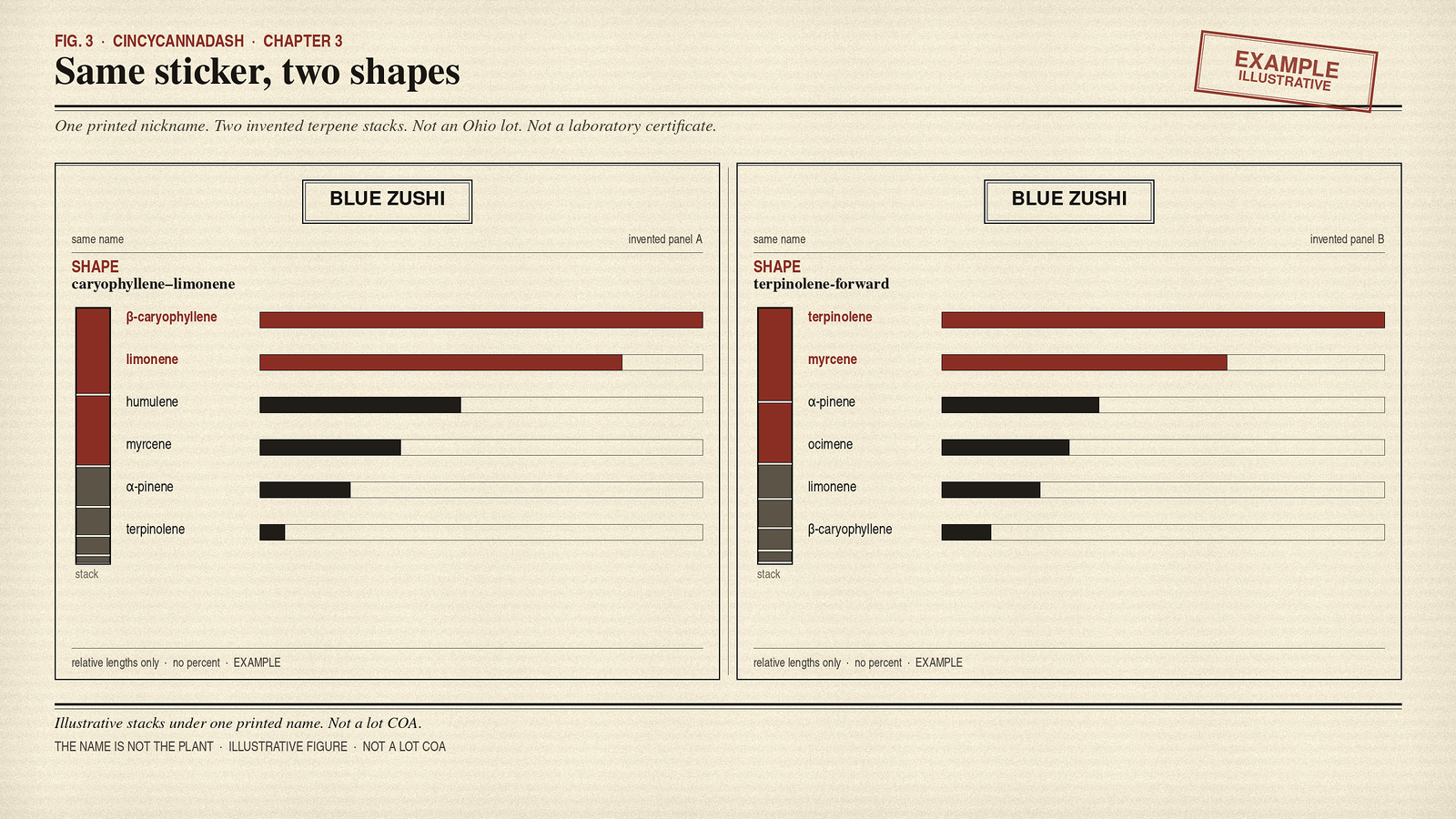
Read the terpene row on the COA. Not the total. The named rows. Myrcene, pinene, limonene, terpinolene, caryophyllene, humulene. You are looking for a neighborhood, not a brand. Caryophyllene–limonene is one plant-feeling. Myrcene–pinene is another. Terpinolene-forward is the one people call "classic" when they mean a 1990s profile. If last month's jar of this name was terpinolene and this month's is a caryophyllene stack, you did not get a moodier cut of the same herb. You got a different chemovar wearing last month's nickname.
Treat the sticker as a nickname. Useful the way a nickname is useful. Not a pedigree. Not an effect code. Not a promise that the next eighth is the last eighth. If you like a jar, write down the terpene shape and the producer and the date, not just the word the printer had.
The five-point review is the same set as the last two chapters. It just points at a different failure:
- Visual — intact frost versus smeared or bald heads. That is still the balloon from chapter 2. A loupe will tell you whether the tanks are on. It will not tell you the name is true.
- Terpene verification — a full-panel COA with a terpene table. This chapter's whole argument. The panel is the plant.
- Potency confirmation — the cannabinoid row, because it is the legal backbone, not because a THC percent is an identity. Amnesia and White Widow already failed that test as groups.
- Compliance screening — pesticides, heavy metals, microbials. A correctly named jar that fails a screen is still a fail.
- Freshness / handling — the still from chapter 1. A stripped jar can make two real chemovars smell like the same spice drawer. Do not diagnose a name-swap off a dead monoterpene fraction.
This site does not grade flower by a sticker. It grades flower by the panel, the date, the nose, and whether the balloons are still balloons. Southern Ohio humidity will not invent a second plant for you, and it will not save a rumor. Crack the jar. Read the row. Keep the nickname if it helps you find the next one. Do not confuse it with the plant.
The name on the lid is not the plant.
Sources
- Fischedick JT, Hazekamp A, Erkelens T, Choi YH, Verpoorte R. Metabolic fingerprinting of Cannabis sativa L., cannabinoids and terpenoids for chemotaxonomic and drug standardization purposes. Phytochemistry. 2010;71(17-18):2058–2073. Abstract-level only in this pass: under controlled conditions, 11 varieties were chemically discriminable by the combined cannabinoid + terpene fingerprint. Not a retail-name study. https://doi.org/10.1016/j.phytochem.2010.10.001
- Hazekamp A, Fischedick JT. Cannabis — from cultivar to chemovar. Drug Testing and Analysis. 2012;4(7-8):660–667. Amnesia vs White Widow: mean THC did not separate them; terpenes and minors did. Three purchased samples chemically matched the other name; authors assumed mix-up and excluded them. Dutch coffee shops, not Ohio. https://doi.org/10.1002/dta.407
- Hazekamp A, Tejkalová K, Papadimitriou S. Cannabis: from cultivar to chemovar II — a metabolomics approach to cannabis classification. Cannabis and Cannabinoid Research. 2016;1(1):202–215. Supplier-labeled Sativa vs Indica: no mean THC/CBD difference; terpenes did the split as group averages. Netherlands only. https://doi.org/10.1089/can.2016.0017
- Fischedick JT. Identification of terpenoid chemotypes among high (−)-trans-Δ⁹-tetrahydrocannabinol-producing Cannabis sativa L. cultivars. Cannabis and Cannabinoid Research. 2017;2(1):34–47. One California retailer, one year of high-THC flower: terpene classes under names that sometimes sit in a chemotype and sometimes sit on a continuum. https://doi.org/10.1089/can.2016.0040
- Reimann-Philipp U, Speck M, Orser C, Johnson S, Hilyard A, Turner H, Stokes AJ, Small-Howard AL. Cannabis chemovar nomenclature misrepresents chemical and genetic diversity; survey of variations in chemical profiles and genetic markers in Nevada medical cannabis samples. Cannabis and Cannabinoid Research. 2020;5(3):215–230. 396 cleaned names over three terpene clusters. Not a same-name mismatch table. https://doi.org/10.1089/can.2018.0063
- Smith CJ, Vergara D, Keegan B, Jikomes N. The phytochemical diversity of commercial Cannabis in the United States. PLoS ONE. 2022;17(5):e0267498. Three recurring THC-dominant terpene shapes; names beat chance and beat indica/sativa labels; none replace a terpene panel. https://doi.org/10.1371/journal.pone.0267498
- Jikomes N, Zoorob M. The cannabinoid content of legal cannabis in Washington State varies systematically across testing facilities and popular consumer products. Scientific Reports. 2018;8:4519. Indica/sativa/hybrid category explains about 1.6% of THC variance in matched Washington flower. Not a terpene paper. https://doi.org/10.1038/s41598-018-22755-2
- Schwabe AL, Naibauer SK, McGlaughlin ME, Gilbert AN. Human olfactory discrimination of genetic variation within Cannabis strains. Frontiers in Psychology. 2022;13:942694. Within-name genetic outliers were often outside the consensus aroma; even genetically matching samples did not all share an aroma cluster. https://doi.org/10.3389/fpsyg.2022.942694
- Schwabe AL, McGlaughlin ME. Genetic tools for strain-reliability misconceptions in Cannabis sativa (journal title uses a banned market verb; cited without quoting it). Journal of Cannabis Research. 2019;1:3. Most of 30 retail names had at least one genetic outlier; after outlier removal, many names still showed a related core. No "true" reference genotype. https://doi.org/10.1186/s42238-019-0001-1
- Sawler J, Stout JM, Gardner KM, Hudson D, Vidmar J, Butler L, Page JE, Myles S. The genetic structure of Cannabis and hemp (journal title uses a banned market word; cited without quoting it). PLoS ONE. 2015;10(8):e0133292. In 6 of 17 same-name comparisons, the sample was genetically closer to a different name than to its own. Small n. Title word is the paper's; this article does not use it in the body. https://doi.org/10.1371/journal.pone.0133292
- Watts S, McElroy M, Migicovsky Z, Maassen H, van Velzen R, Myles S. Cannabis labelling is associated with genetic variation in terpene synthase genes. Nature Plants. 2021;7:1330–1334. Same-name pairs often as genetically and chemically distant as different-name pairs. Indica/sativa label tracks a few aroma-terpene loci, not genome-wide ancestry. Dutch Hazekamp 2016 material; Bedrocan funded, disclosed. https://doi.org/10.1038/s41477-021-01003-y
- Soler S, Gramazio P, Figàs MR, Vilanova S, Rosa E, Llosa ER, Borràs D, Plazas M, Prohens J. Genetic structure of Cannabis sativa var. indica cultivars based on genomic SSR (gSSR) markers: implications for breeding and germplasm management. Industrial Crops and Products. 2017;104:171–178. Named seed lots: large within-cultivar variation. Seed-grown breeding material, not shop jars. Abstract / author-copy level in this pass. https://doi.org/10.1016/j.indcrop.2017.04.043
- Berman P, Futoran K, Lewitus GM, Mukha D, Benami M, Shlomi T, Meiri D. A new ESI-LC/MS approach for comprehensive metabolic profiling of phytocannabinoids in Cannabis. Scientific Reports. 2018;8:14280. Same mother line, four greenhouses, same plant/harvest protocol: minor acids and the propyl series moved. Not a name-swap paper. Cannabinoids only. https://doi.org/10.1038/s41598-018-32651-4
Flagged / not used as claims: Hazekamp and Fischedick 2012 8/40 "not a reliable service" arithmetic (their Dutch coffee-shop visits, not an Ohio or national fraud rate); Schwabe et al. 2023 sticker-THC versus retest (potency inflation, not name-versus-chemistry); Elzinga et al. 2015, Herwig et al. 2025, and Zoorob 2021 (full texts not pulled in the research pass); any invented Ohio mislabel rate; "every same-name pair is a different plant"; indica/sativa as empty folklore period; Berman's mouse PTZ assay as a human outcome.
Series note
This is chapter 3 of a CincyCannaDash quality library. Chapter 1 was the jar as still: /blog/your-cannabis-jar-is-a-still/. Chapter 2 was the heads: /blog/amber-is-senescence/. The still runs. The balloons leak. The lid is a rumor. Next is not locked yet.
The live board is today's menu. Dated lab reports sit next to the lots, and areas lists the Southern Ohio towns we already serve. 21+. (513) 986-5438.
More notes
- The lid ring is the seal
- The tape is the memory
- The working jar is the small one
- The bag is not a jar
- The empty jar is a bigger still
- The grind is the last harvest
- Two OGs, same family
- The fridge is a wet box
- Light is the faster insult
- The dash is a kiln
- The pack is not a cure
- The freezer is not a time machine
- Amber is senescence
- How pick up and delivery works
- How to read a lab report
- Your cannabis jar is a still