
You were only going in for a minute. You left the eighth on the dash so you would not forget it. The lid was on. Maybe it was only seventy-something outside. You come back and you cannot hold the wheel. The glass is hotter than the sidewalk. The nugs still look kind. That car was an oven.
Take the jar with you.
Do it even when the sidewalk feels fine. Do it even if you cracked the windows. Do it even if you hid it under the seat. Under the seat is still the car. The dash is just the worst seat in it.
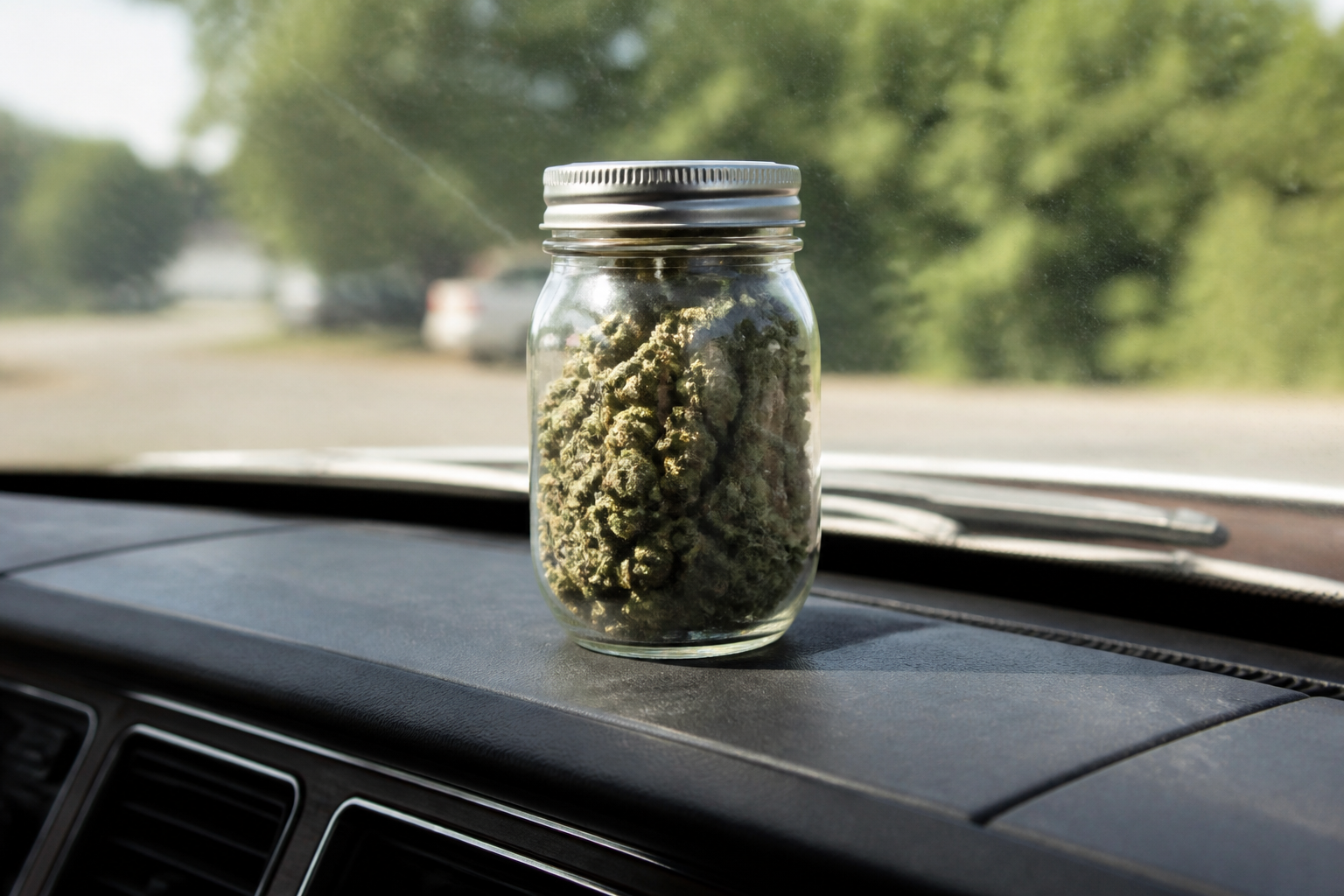
How to keep the jar
Take it inside with you. A closed car in the sun is not storage, even on a mild day. Cracked windows do not save it. Shade inside that car is still that car.
Chapter 4 was months in a cool room. Chapter 6 was a windowsill in a house. This is the errand.
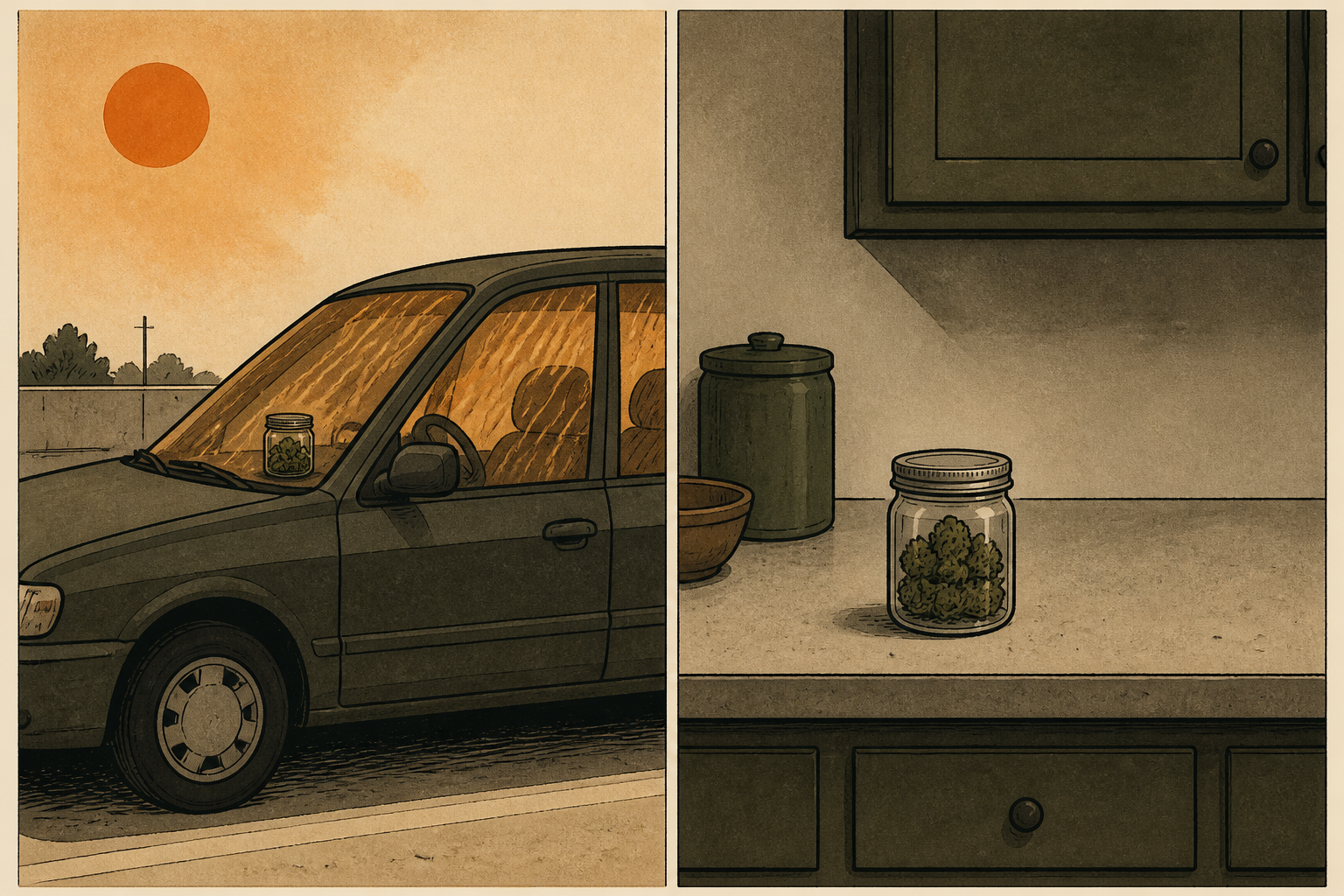
They did measure the air in a parked Honda. Not the flower. The air. On a 72 °F day the cabin still hit 117 °F in an hour. About 80 percent of that climb happened in the first thirty minutes. Windows cracked an inch and a half did not save the room (McLaren, Null, and Quinn, 2005, https://doi.org/10.1542/peds.2004-2368).
The cupboard paper people quote for "heat did not matter" stopped at 20 °C, which is 68 °F. That is Fairbairn. That is a dark room, not a dash.
A later cabin model said parked-in-sun air can sit more than 20 °C above the street, and dropping a window a crack did not fix it (Dadour et al., 2011). The National Weather Service says a dark dashboard can run 180 to over 200 °F. That is their safety language, not a trial we ran in a lot.
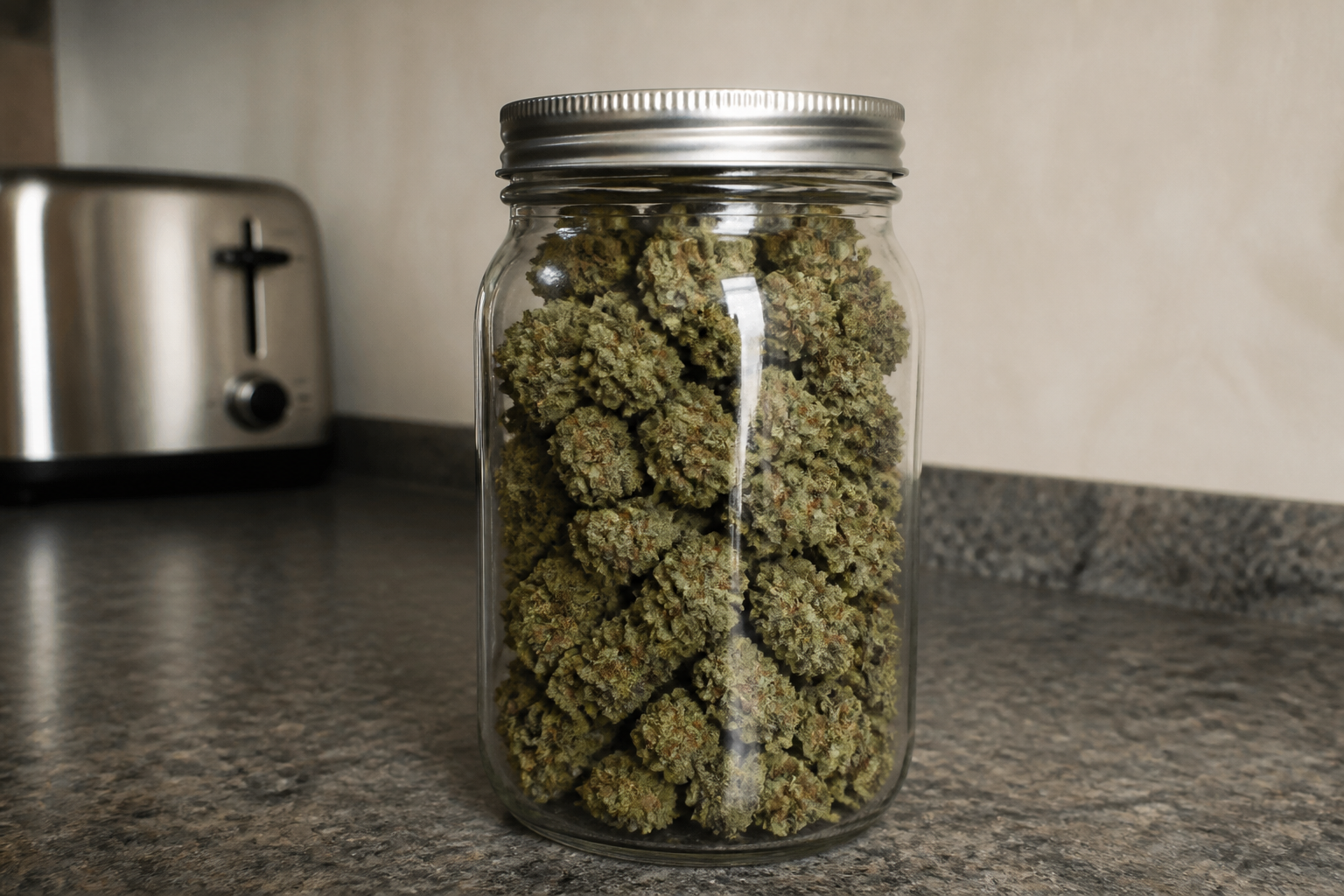
Nobody put dried flower in that Honda and published the nose. I am not inventing an n. I am not borrowing an extract oven at 80 °C and pretending it is your dash. I am not saying how much gas left after one hour on the glass.
The keep is still the keep. Take the jar with you.
McLaren 2005 is cabin air, one sedan, California sun, sixty minutes. It is not Cincinnati and it is not a jar. Dadour 2011 is an abstract this pass. The NWS dashboard range is comms, not a methods table. Wang 2016 decarboxylated extracts in a vacuum oven at 80 °C and up. That clock stays off this dash. I did not find a flower-in-vehicle paper. I am not filling that hole.
21+. Educational. No medical claims. This is about how you keep the flower.
Sources
- McLaren C, Null J, Quinn J. Heat stress from enclosed vehicles: moderate ambient temperatures cause significant temperature rise in enclosed vehicles. Pediatrics. 2005;116(1):e109–e112. Cabin air, not flower. Dark-blue Honda Accord, 16 clear days, Fremont, CA. Ambient 72–96 °F. Sensor in shade, 15 inches above rear seat. ~80% of the rise in the first 30 minutes. On a 72 °F day, cabin air reached 117 °F in 60 minutes. About 40 °F gain across the range. Windows cracked 1.5 inches did not save the room. A/C pre-cool bought about 5 minutes. https://doi.org/10.1542/peds.2004-2368
- Fairbairn JW, Liebmann JA, Rowan MG. The stability of cannabis and its preparations on storage. Journal of Pharmacy and Pharmacology. 1976;28(1):1–7. Temperature up to 20 °C (68 °F) described as insignificant in that design. That clause does not cover a parked car. https://doi.org/10.1111/j.2042-7158.1976.tb04014.x
- Dadour IR, Almanjahie I, Fowkes ND, Keady G, Vijayan K. Temperature variations in a parked car. Forensic Science International. 2011;207(1-3):205–211. Abstract this pass. Cabin air model, not flower. https://doi.org/10.1016/j.forsciint.2010.10.009
- National Weather Service. Children, Pets and Vehicles. Comms language for dashboard temperatures (180 to over 200 °F). Not a methods table and not a flower trial.
Flagged / not used as numbers: any flower-in-car n (none found); Wang 2016 extract oven clocks at 80 °C; treating Fairbairn’s 20 °C clause as a parked-car result; treating McLaren’s cabin air as a terpene or acid panel.
Series note
This is chapter 7 of a CincyCannaDash quality library. The still runs. The closed car is a kiln. Next is not locked.
The live board is today's menu. Dated lab reports sit next to the lots, and areas lists the Southern Ohio towns we already serve. 21+. (513) 986-5438.
More notes
- The lid ring is the seal
- The tape is the memory
- The working jar is the small one
- The bag is not a jar
- The empty jar is a bigger still
- The grind is the last harvest
- Two OGs, same family
- The fridge is a wet box
- Light is the faster insult
- The pack is not a cure
- The freezer is not a time machine
- Amber is senescence
- The name is not the plant
- How pick up and delivery works
- How to read a lab report
- Your cannabis jar is a still