
You pull a jar out of the freezer like you hid a secret. Frost on the glass. The nugs still look loud. Sticky, sugared, the kind you meant to save, still a little heady in the glass. You crack the lid and the room does not fill the way it did the night you put it away. The herb is still there. The gas is thinner. Somebody told you cold would pause the clock. The clock kept running on the nose.
That is the argument Southern Ohio already has, just usually shouted over a tray. One person freezes the extra eighth for later. One person leaves a sealed jar on the dash, or on the warm shelf above the stove, and swears nothing happened because nobody opened it. One person grinds a week's worth on Sunday so weeknights are easy. Same batch. Three different rooms. Three different plants by the time you smell them.
The jar is a still was what leaves when you crack the lid. Amber is senescence was the balloon that feeds it. The name is not the plant was the rumor on the sticker. This chapter is the sealed jar that never moved, and still changed. The freezer myth is half true. Watch only THC turn into CBN over years, and the cold room looks like a vault. Watch the nose on dried flower, and deep freeze is one of the worst rooms in the one open study that measured both.
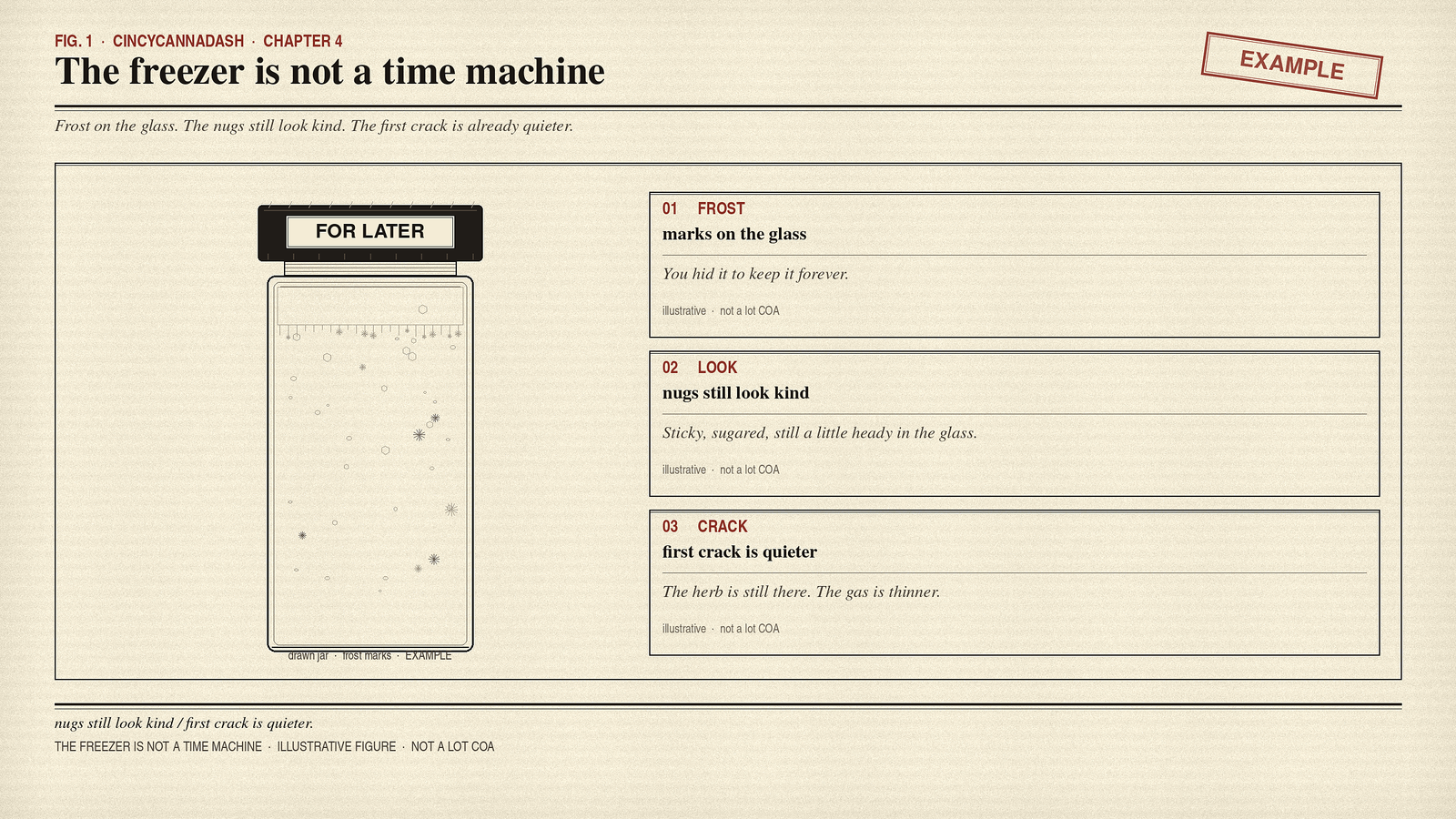
The freezer looks like a vault if you only watch THC
People freeze flower because the potency papers told them to, even if they never read the papers. Leave high-THC material warm for years and the THC line falls while CBN climbs. Do that in the light and it falls faster. Put the same material in the dark at −20 °C and that clock almost stops. If the only question you ask is whether the THC held, the freezer wins.
A four-year forensic set of six high-potency products (herbal and resin together, not a flower-only tray) sat in four rooms: light at 22 °C, dark at 22 °C, dark at 4 °C, and dark at −20 °C. Under the two warm rooms, the abstract says almost all the THC was gone after four years. Temperature changed the speed. Light changed the speed and the way THC became CBN. The freezer condition is the one those write-ups call best for keeping that line still (Zamengo, Bettin, Badocco, Di Marco, Miolo, and Frison, 2019, https://doi.org/10.1016/j.forsciint.2019.02.058).
An older herbal set from ten regions said the same kind of thing with a messier design. Darkness at 4 °C beat lab light at 22 °C. The loss was faster in year one than later. Light and heat were tied together, so you cannot peel them apart and call it a clean temperature trial. It was seizure herb, not a cured jar you meant to keep (Trofin, Vlad, Dabija, and Filipescu, 2011).
Those papers watched THC, CBN, and CBD. They did not watch the nose. The forensic set mixed flower with resin. The method that made those THC numbers (GC-FID) cooks the native acids as part of the measurement. That is not what acids were still acids in the jar. The PDFs were not on the table. The abstract is. I am not pulling extra percentages out of secondary write-ups. Those papers are not wrong about THC if THC is all you measure. Do not walk away thinking the freezer kills potency. It does not.
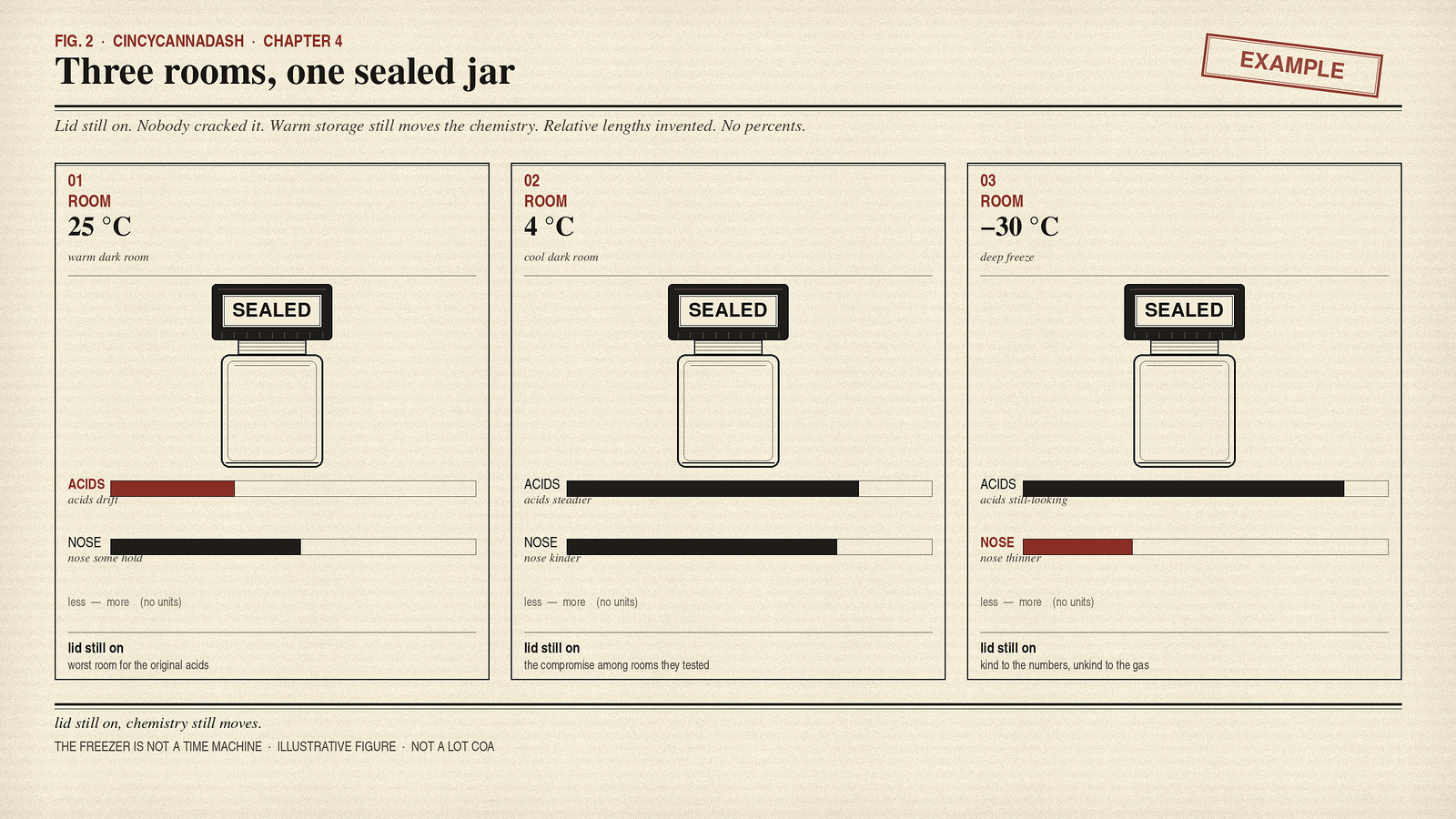
Room heat moves the acids even if you never open the lid
A sealed jar on a warm shelf is not a vault either. You already knew the still runs when you open it. This is the quieter insult: the profile drifts while the lid stays shut.
The open flower study that tracked both the native acids and the terpenes put two cured chemovars (one THC-forward, one CBD-forward) into dark bottles at 25 °C, 4 °C, −30 °C, and −80 °C, whole and ground, three bottles per condition. They had already cured a month at 21 °C and 60 percent RH. Moisture sat near nine percent and did not wander with temperature. Not a drying-out story in disguise. Whole flower: 15 grams in a 100 mL bottle. Ground: 7.5 grams in a 20 mL bottle. Cannabinoids every four months for a year. Terpenes at the start and at four months, and only on the CBD-forward plant (Milay, Berman, Shapira, Guberman, and Meiri, 2020, https://doi.org/10.3389/fpls.2020.583605).
Room temperature was the worst room for the original acid profile. After a year at 25 °C, the THC-forward plant had lost about a third of its THCA, whole and ground alike. Neutral THC, CBD, and CBN were already up hard by month four across the temperatures. Decarboxylation does not wait for you to crack the lid. The biggest THC and CBD rises landed at 25 °C at a year. If you use CBN as a "how old is this" tell, know the limit they printed: on the CBD-forward chemovar, CBN stayed under 0.01 percent even at a year. A bad aging marker for that chemistry. Do not read a flat CBN line as a young jar.
n equals three. Two chemovars. Dark lab bottles. That is not your household fridge, and it is not a Southern Ohio cupboard survey. It is still the one open flower trial that measured the acids and the nose, and on the acids the warm dark room lost.
An older pharmacy paper sits next to that without canceling it. Light, not even direct sun, was the biggest single insult to the cannabinoid line. Temperature up to 20 °C barely moved their herbal samples. Intact gland heads behaved like small closed containers. Carefully prepared herb, stored dark at room temperature, can be reasonably stable for a year or two (Fairbairn, Liebmann, and Rowan, 1976, https://doi.org/10.1111/j.2042-7158.1976.tb04014.x). Different material, different methods, a potency endpoint, not a native-acid panel. Keep it for the light lesson and the intact-head lesson. Do not use it to talk yourself into a hot shelf.
Deep freeze is a bad room for the nose
Here is the part nobody tells you when they freeze the extra eighth. The terpenes were already down hard by four months in every room they tested. All of them. The authors' own summary is the one worth keeping: average terpenoid loss was over 50 percent by month four, against about 26 percent average loss of the cannabinoids the plant had actually made, and that cannabinoid number is at a year, not at four months. The nose moves first. The numbers lag.
Deep freeze was among the worst rooms for that nose. Minus 80 °C, and generally anything under −20 °C, sat on the unkind side of the terpene panel. α-Pinene was especially lower at −80 and −30 than it was at 4 or 25. β-Caryophyllene sagged mainly at −80. The loud fraction (the pine, the lift, the thing that walks into the room ahead of you) is the one that hates the deep cold in this design (Milay et al., 2020).
The terpene clock in that paper stops at four months. It does not run to twelve. I am not stretching a four-month table into a year-long aroma story. One chemovar for the terpenes, the CBD-forward one. Three bottles. Minus 30 and minus 80 are not a household frost-free. The finding still splits the myth: the temperature that looks kindest to THC is not the temperature that looks kindest to the gas.
Forum lore says ice snaps the heads off. Maybe it does in a bag you toss around. These papers do not publish an n for that. I am not inventing one, and I am not saying the freezer killed the potency. It was a poor room for the terpenes they measured, and a fine-looking room if you only watch THC.
The same lab ran oils. Oils are a different clock. Extracts fall apart much faster than solid material. Acidic THC half-lives in resin sit on the order of hundreds of days, in extracts on the order of tens (Lindholst, 2010, https://doi.org/10.1080/00450610903258144). A lot of freezer gospel was written for concentrates and then hung on a jar of nugs. This chapter is the dried flower.
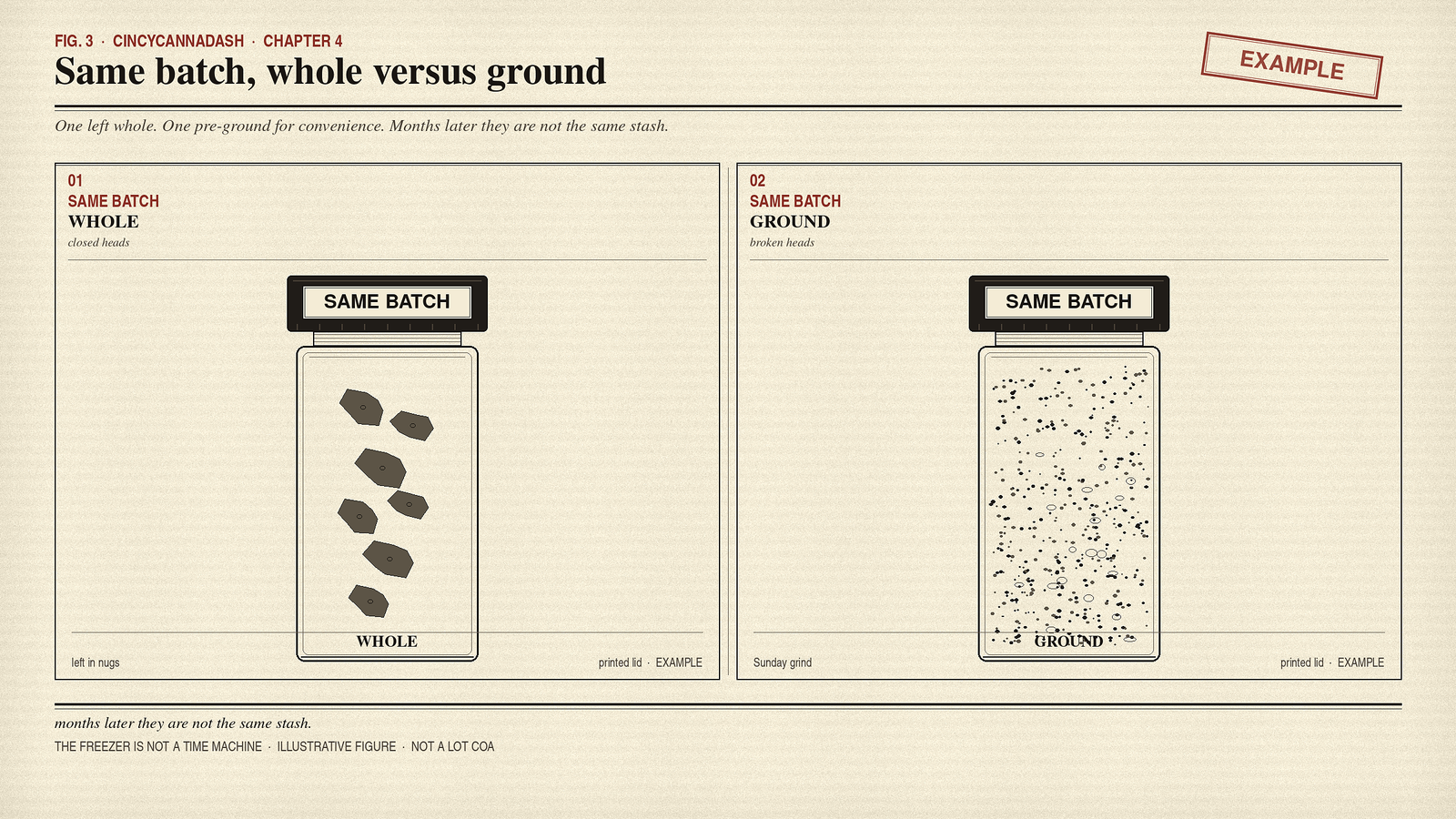
Whole nugs beat a Sunday grind
The other split in that flower study is the one you can do tonight without a freezer. Ground flower held terpenes worse than whole flower. Grinding also pushed more oxidation products. More surface, more air, more chemistry you did not ask for. That matches the old intact-gland intuition. The head is a closed tank until you break it. A pre-ground stash jar is a tank you opened on purpose and then left open, microscopically, for months (Milay et al., 2020; Fairbairn et al., 1976).
Two jars from the same batch. One left in nugs. One ground on Sunday because weeknights are easier. Crack them side by side after a season and you are not comparing "the same kind, just more convenient." You are comparing a closed forest to a pile of broken heads.
Cool, dark, and whole, and your fridge is not the lab
Among the rooms they actually tested, the authors landed where a tray person already half-knew: whole inflorescences, 4 °C, in the dark. Best compromise for the original mix. Room heat was worst for the acids. Deep freeze was among the worst for the nose. Ground lost to whole.
A kitchen fridge is not that experiment. The lab bottles stayed dark. They did not sit next to onions. Nobody opened the door for leftovers. Your fridge is not a proven vault, and a fridge does not always beat a cool dark cupboard for a short stash. Fairbairn's dark room-temp herb is still in the pile. Milay's 25 °C acid drift is also in the pile. For a jar you mean to finish this month, a dark cupboard that does not bake is not a failure the papers proved.
What they do support, without stretching: do not leave the sealed jar on a warm dash and call it unchanged. Do not freeze dried flower to keep the loud and then act surprised when the first crack is thinner. Do not grind the whole stash and then blame the cultivar. Keep it whole, dark, and cool. Cold storage is careful storage. Not a time machine. Not a produce drawer.
The five-point review is the same set as the last three chapters. It just points at a different failure.
- Visual — intact frost versus smeared or bald heads. Still the balloon from chapter 2. Cold storage does not get a free pass on a smashed jar.
- Terpene verification — a dated full-panel COA with a terpene table. The freezer can hold a THC number and still be a quieter plant than the table described.
- Potency confirmation — the cannabinoid row, the legal backbone, not proof a frozen percent is a fresh jar. On a CBD-forward plant, CBN may not even tell you it aged.
- Compliance screening — pesticides, heavy metals, microbials. A well-stored jar that fails a screen is still a fail.
- Freshness / handling — where the sealed jar lived. Warm shelf, freezer bag, Sunday grind. Chapter 1 was the still you run when you open it. This is what moved while you did not.
This site does not grade flower by how long it survived a freezer. It grades flower by the panel, the date, the nose, and whether the nugs are still nugs. Southern Ohio summer will cook a dash jar without asking you. A basement cupboard will not make a pre-ground eighth loud again. Comparing two lids means knowing what the room did to each jar before you smelled it.
The freezer is not a time machine.
Sources
- Milay L, Berman P, Shapira A, Guberman O, Meiri D. Metabolic profiling of cannabis secondary metabolites for evaluation of optimal postharvest storage conditions. Frontiers in Plant Science. 2020;11:583605. Open access. Two medical chemovars (Type I "Lemon Kush," Type III "Golan"); whole vs ground; dark storage at 25, 4, −30, −80 °C; n = 3. Cannabinoids to 12 months; terpenes on Type III only, t0 and t4. Authors' landing: whole inflorescences at 4 °C. https://doi.org/10.3389/fpls.2020.583605
- Zamengo L, Bettin C, Badocco D, Di Marco V, Miolo G, Frison G. The role of time and storage conditions on hashish and herbal-sample composition over four years (journal title uses a banned market word; cited without quoting it). Forensic Science International. 2019;298:131–137. Abstract-level in this pass: six high-potency products, herbal and resin; four conditions over ~4 years; almost 100% THC degraded after four years under the two 22 °C rooms; freezer described as best for the THC/CBN line. GC-FID (acids decarboxylated in analysis). No terpene panel. Title words are the paper's; this article does not use them in the body. https://doi.org/10.1016/j.forsciint.2019.02.058
- Trofin IG, Vlad CC, Dabija G, Filipescu L. Influence of storage conditions on the chemical potency of herbal cannabis. Revista de Chimie (Bucharest). 2011;62(6):639–645. Abstract-level only: herbal material from ten regions; up to 4 years; darkness at 4 °C vs lab light at 22 °C; faster Δ9-THC loss in year 1; loss more pronounced in the light/warm room. Light and temperature confounded. Seizure herb, not cured medical flower. Secondary percentages from mirrors were not used. https://revistadechimie.ro/Articles.asp?ID=3004
- Fairbairn JW, Liebmann JA, Rowan MG. The stability of cannabis and its preparations on storage. Journal of Pharmacy and Pharmacology. 1976;28(1):1–7. Abstract-level: solutions, nine herbal plus two resin samples, up to 2 years. Light (not direct sun) the greatest single factor in cannabinoid loss. Temperature effect up to 20 °C described as insignificant for their herbal conditions; intact glands as closed containers; reasonably stable 1–2 years if stored dark at room temperature. Different endpoint than Milay's native-acid panel. https://doi.org/10.1111/j.2042-7158.1976.tb04014.x
- Lindholst C. Long term stability of cannabis resin and cannabis extracts. Australian Journal of Forensic Sciences. 2010;42(3):181–190. Contrast only, not flower advice. Resin and extracts at room temperature / 4 °C / −20 °C up to 4 years; acidic THC half-lives in resin ~330 d (daylight) / ~462 d (darkness); extracts much faster (~35 / ~91 d). https://doi.org/10.1080/00450610903258144
Flagged / not used as numbers: secondary Zamengo figures of ~50% THC reduction in ~700 days under the warm-light condition and ~10% THC loss over four years at −20 °C (not locked to the PDF); Trofin mirror figures of ~85.31% / ~89.79% four-year Δ9-THC loss and the year-1 remaining-percent pair (not locked to the PDF); ASTM D8197-22 water-activity band (a specification, not this chapter's experiment); industry-blog "trichomes shatter in the freezer" counts (not primary; no n in these papers); any claim that a household fridge matches the 4 °C dark-bottle condition; any claim that the freezer destroys potency; any 12-month terpene story (Milay's terpene timepoints stop at t4); Milay's DMSO / ethanol / olive-oil arm, except as the one-line oils-are-different note.
Series note
This is chapter 4 of a CincyCannaDash quality library. Chapter 1 was the jar as still: /blog/your-cannabis-jar-is-a-still/. Chapter 2 was the heads: /blog/amber-is-senescence/. Chapter 3 was the name: /blog/same-name-is-not-the-plant/. The still runs. The balloons leak. The lid is a rumor. The sealed jar still ages. Next is not locked.
The live board is today's menu. Dated lab reports sit next to the lots, and areas lists the Southern Ohio towns we already serve. 21+. (513) 986-5438.
More notes
- The lid ring is the seal
- The tape is the memory
- The working jar is the small one
- The bag is not a jar
- The empty jar is a bigger still
- The grind is the last harvest
- Two OGs, same family
- The fridge is a wet box
- Light is the faster insult
- The dash is a kiln
- The pack is not a cure
- Amber is senescence
- The name is not the plant
- How pick up and delivery works
- How to read a lab report
- Your cannabis jar is a still