
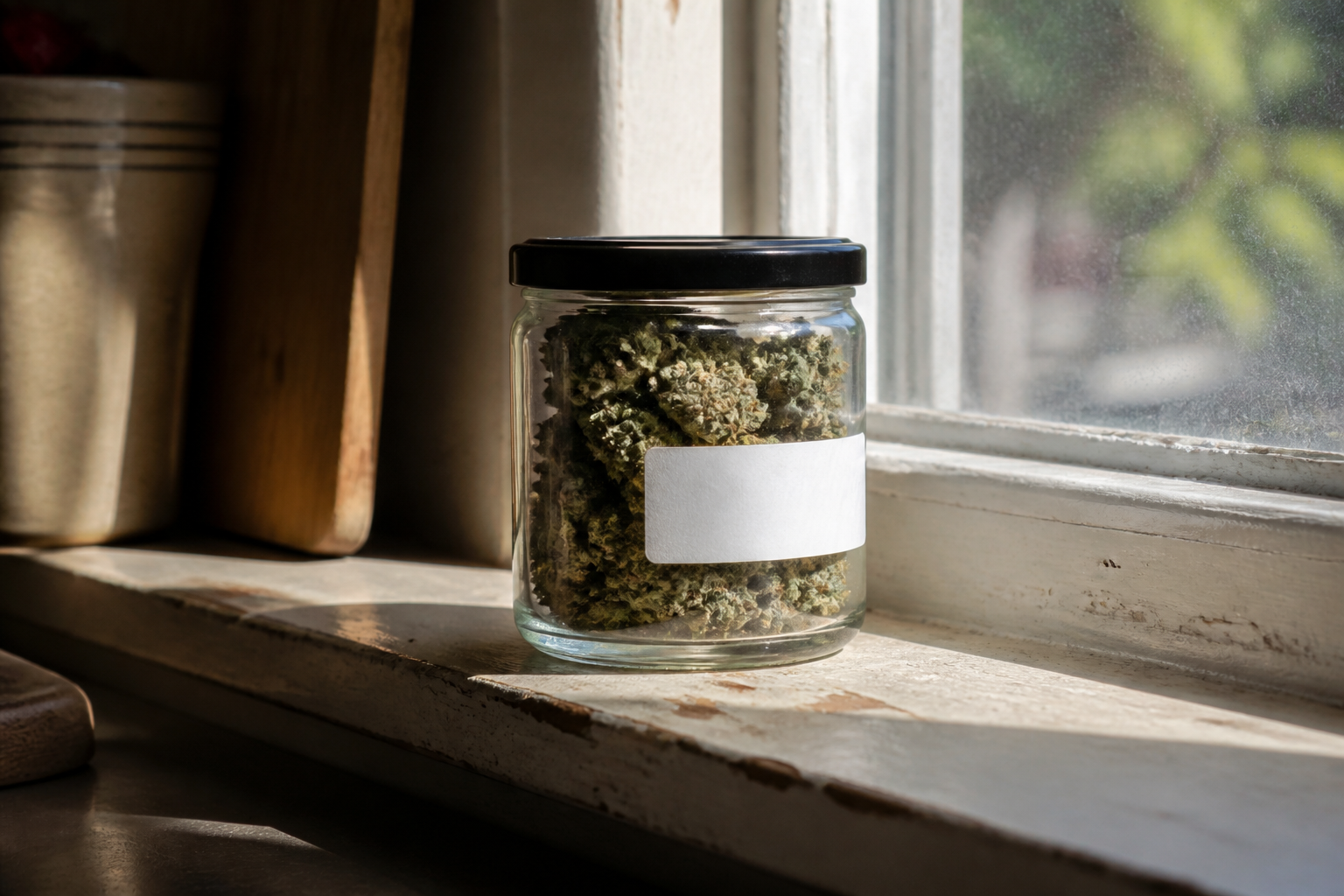
You set a clear jar on the windowsill because the lid was tight and the room looked pretty. Morning light sits on the glass. The nugs still look kind from the couch. Nobody cracked it. You tell yourself the seal is the keep. The keep was the cupboard.
That is the argument Southern Ohio already has when somebody parks an eighth where the sun can see it. One person swears the lid is enough. One person hides every jar in a closet like a secret. One person leaves a jar on the dash just for the drive. Same batch. Different rooms. Dark first. A cupboard beats a sunny counter.
The jar is a still was what leaves when you open it. Amber is senescence was the balloon. The name is not the plant was the sticker. The freezer is not a time machine was temperature. The pack is not a cure is moisture. This one is the window.
How to keep the jar
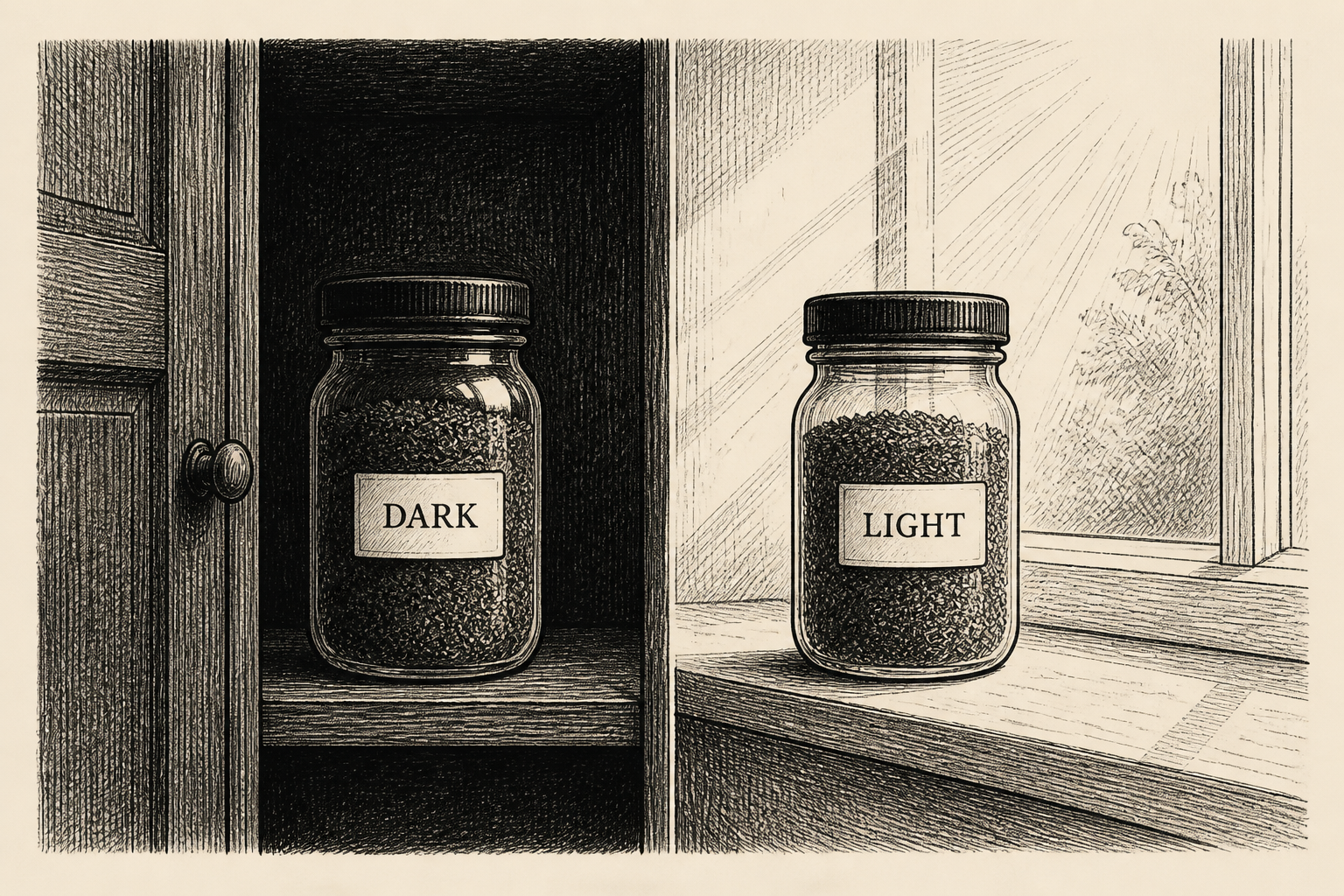
Put it in the dark. A cupboard beats a sunny counter. A closet beats a sill. Leave it in nugs. The heads are small closed tanks until you break them. Cool still helps, and that is Chapter 4. A pack still does not pause the nose, and that is Chapter 5. Tonight the keep is darkness.
Move the clear jar off the bright spot.
Ordinary indoor light was already enough
They did not need a July dashboard to call light the faster insult. Ordinary indoor light was already the big one. A sunny sill is not a kinder room.
Fairbairn, Liebmann, and Rowan stored solutions of pure cannabinoids, nine samples of herbal material, and two of resin, one of them freshly prepared, under varying conditions for up to two years. They said exposure to light, and they were careful to say not direct sunlight, was the greatest single factor in loss of cannabinoids, especially in solutions. Temperature, up to 20 °C, was insignificant in that design. Air oxidation did take a bite, and they said you could shrink that bite by not wrecking the glands, which act as well filled, well closed containers. Loss of THC in the light did not build CBN. Air oxidation in the dark did. Carefully prepared herbal or resin or extracts are reasonably stable for one to two years if stored in the dark at room temperature (Fairbairn, Liebmann, and Rowan, 1976, https://doi.org/10.1111/j.2042-7158.1976.tb04014.x).
That is the abstract. The full PDF was gated this pass. I am not inventing an n for each shelf, and I am not pulling extra percents out of a blog that claims to have the tables. This is a cannabinoid line, not a terpene panel. I am not saying the nose held in the cupboard. I am saying the cannabinoid line liked the dark.
Do not hang extract clocks on nugs
You will hear half-lives. People love half-lives. Lindholst 2010 is the paper that gets quoted for them, and it is resin slabs and extracts, stored up to four years at room temperature, 4 °C, and −20 °C. Acidic THC in resin ran on the order of hundreds of days. The same clock in extract ran on the order of tens. Darkness helped. Extraction made light worse (Lindholst, 2010, https://doi.org/10.1080/00450610903258144).
That is not your eighth. Do not put 35 days or 330 days on a jar of nugs and call it Fairbairn. Those numbers stay on resin and extract. Chapter 4 already said a lot of freezer talk was written for concentrates and then hung on nugs. Light talk gets borrowed the same way.
Dark does not cancel the rest
Dark does not cancel a hot shelf. Chapter 4 still owns temperature once you leave that 20 °C neighborhood. Dark does not cancel a wet jar or a Sunday grind. Whole, cool, and dry still matter. Light is the insult people forget because the lid looks closed and the room looks fine.
Intact heads still matter in their language. If you grind the stash and then park it in a window, you gave the light and the air more surface. I do not have an n for that pairing in Fairbairn. I am not inventing one. Leave it whole, and put it away.
Sources
- Fairbairn JW, Liebmann JA, Rowan MG. The stability of cannabis and its preparations on storage. Journal of Pharmacy and Pharmacology. 1976;28(1):1–7. Abstract-only this pass. Nine herbal samples and two resin samples, up to 2 years. Light (not direct sun) the greatest single factor in cannabinoid loss. Temperature up to 20 °C described as insignificant. Glands as well filled, well closed containers. Light-loss of THC did not build CBN; dark air oxidation did. Landing: reasonably stable 1–2 years if stored dark at room temperature. No per-shelf n in the abstract. Not a terpene panel. https://doi.org/10.1111/j.2042-7158.1976.tb04014.x
- Lindholst C. Long term stability of cannabis resin and cannabis extracts. Australian Journal of Forensic Sciences. 2010;42(3):181–190. Contrast only. Resin and extracts, not dried flower. Do not hang these half-lives on nugs. https://doi.org/10.1080/00450610903258144
Flagged / not used as numbers: any per-shelf n from Fairbairn (abstract does not give it); any terpene-panel claim from this paper; hanging Lindholst half-lives on a jar of nugs; treating “up to 20 °C” as a 25 °C trial or a freezer trial; a pairing n for ground flower plus a window.
Series note
This is chapter 6 of a CincyCannaDash quality library. Chapter 1 was the jar as still: /blog/your-cannabis-jar-is-a-still/. Chapter 2 was the heads: /blog/amber-is-senescence/. Chapter 3 was the name: /blog/same-name-is-not-the-plant/. Chapter 4 was temperature: /blog/the-freezer-is-not-a-time-machine/. Chapter 5 is moisture. The still runs. The balloons leak. The lid is a rumor. The sealed jar still ages. Light is the faster insult. Next is not locked.
The live board is today's menu. Dated lab reports sit next to the lots, and areas lists the Southern Ohio towns we already serve. 21+. (513) 986-5438.
More notes
- The lid ring is the seal
- The tape is the memory
- The working jar is the small one
- The bag is not a jar
- The empty jar is a bigger still
- The grind is the last harvest
- Two OGs, same family
- The fridge is a wet box
- The dash is a kiln
- The pack is not a cure
- The freezer is not a time machine
- Amber is senescence
- The name is not the plant
- How pick up and delivery works
- How to read a lab report
- Your cannabis jar is a still